Table of contents
- Yes, AI-written blog posts can rank, but not as raw drafts
- What Google actually cares about when ranking AI-assisted content?
- Why unedited AI posts struggle to rank (and sometimes backfire)?
- 1. They miss search intent
- 2. They repeat surface-level points
- 3. They lack your real-world experience
- 4. They are more likely to contain quiet errors
- 5. They blur accountability
- A safe way to use AI so your posts can actually rank
- Step 1: Decide the topic and angle yourself
- Step 2: Use AI to help with research and an outline
- Step 3: Generate a first draft, tightly guided
- Step 4: Layer in your expertise
- Step 5: Fact-check and correct
- Step 6: Edit for clarity and usefulness
- Can you get results from AI-assisted posts? (Real example)
- How to decide when to use AI vs write or outsource manually?
- Use AI-assisted posts when…
- Prefer fully human (or specialist-written) posts when…
- Ethics and transparency: is it okay to publish AI-assisted content?
- If you want AI-written posts that can rank without becoming tech homework
- FAQs
- Will Google penalize AI-written blog posts?
- Do AI-assisted blog posts need human editing to rank?
- When should I use AI for blogging instead of writing manually?
- Is it ethical to publish AI-assisted content?

TL;DR Yes, AI-written blog posts can rank on Google, but raw AI drafts rarely perform well. The content that wins is guided by real human expertise, edited for accuracy and originality, and written to be genuinely useful to your specific customers. Use AI as a helper inside a human-led process, not as a replacement for you.
If you have ever typed a topic into an AI tool, hit “generate,” and wondered whether Google will actually rank what came out, you are not alone. Many small-business owners feel torn between the speed of AI and the fear of getting buried in search results.
You are right to be suspicious of “press a button, get rankings” promises. But you do not have to avoid AI altogether. You just need a safer way to use it.
At Fasta Blogging, we use AI as an assistant, not as the writer of record. Every account is set up by an SEO specialist and every post is reviewed by a human before it is ready, because that is what it takes for AI-assisted content to work in search.
Let us walk through how to make AI help your blogging, without killing your chances of showing up on Google.
Yes, AI-written blog posts can rank, but not as raw drafts
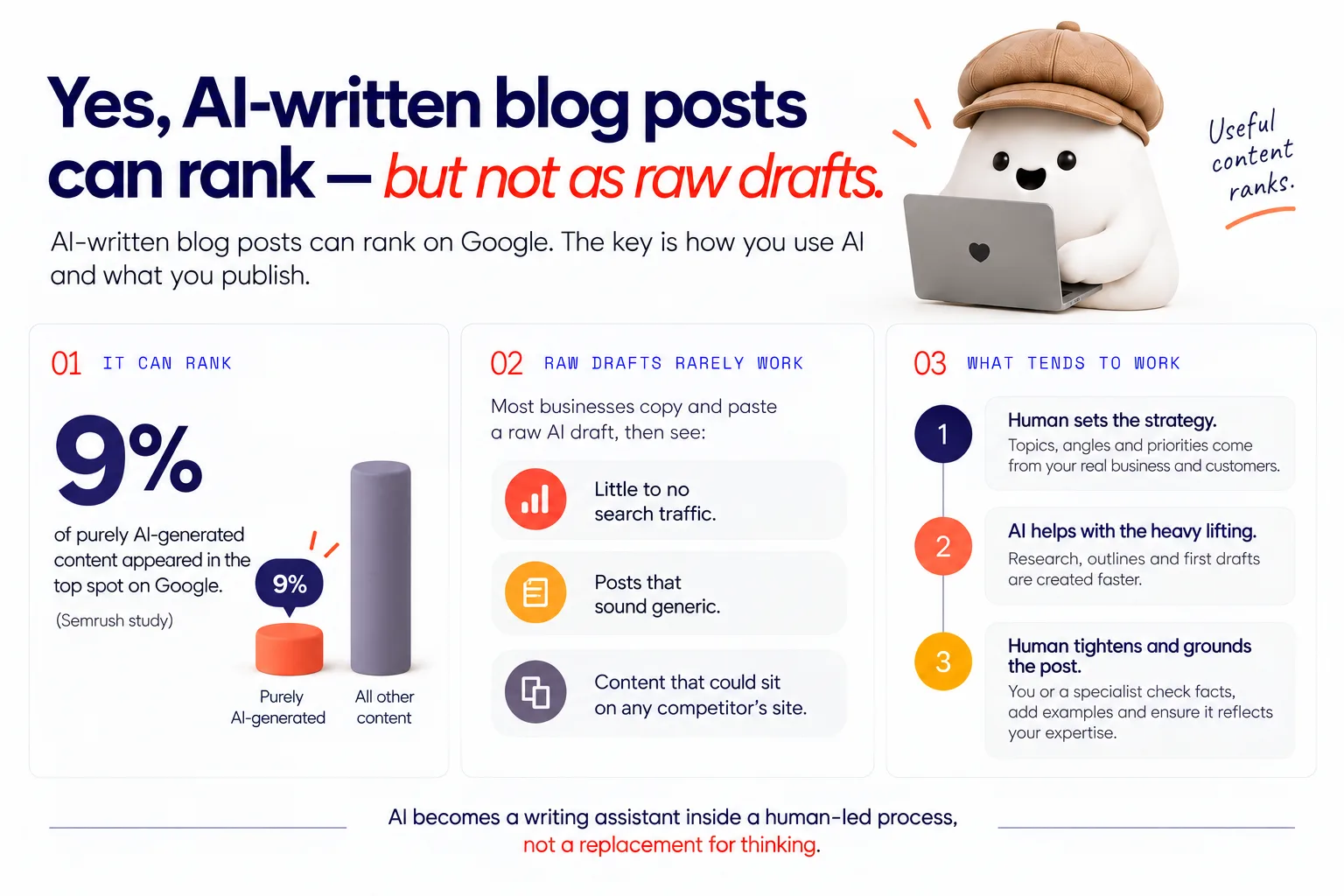
AI-written blog posts can rank on Google. The key is how you use AI and what you publish.
Google’s systems are not hunting for AI fingerprints. They are trying to surface content that is useful, accurate and trustworthy for the searcher.
There is a gap, though, between “can rank in theory” and “actually shows up at the top”.
A Semrush study looking at how different types of content perform found that content classified as purely AI-generated appeared in the top spot just 9% of the time (source).
Neil Patel’s analysis found that human written content outranked AI created content 94.12% of the time (source).
This is the problem most businesses run into. They copy and paste a raw AI draft, hope it works, and then see:
- Little to no search traffic.
- Posts that sound generic.
- Content that could sit on any competitor’s site.
The issue is not that Google has a rule against AI. It is that most unedited AI drafts are not good enough to compete.
What tends to work instead is:
- A human sets the strategy. Topics, angles and priorities come from your real business and customers.
- AI helps with the heavy lifting. Research, outlines and first drafts are created faster.
- A human tightens and grounds the post. You or a specialist check facts, add examples and ensure it reflects your expertise.
AI becomes a writing assistant inside a human-led process, not a replacement for thinking.
What Google actually cares about when ranking AI-assisted content?
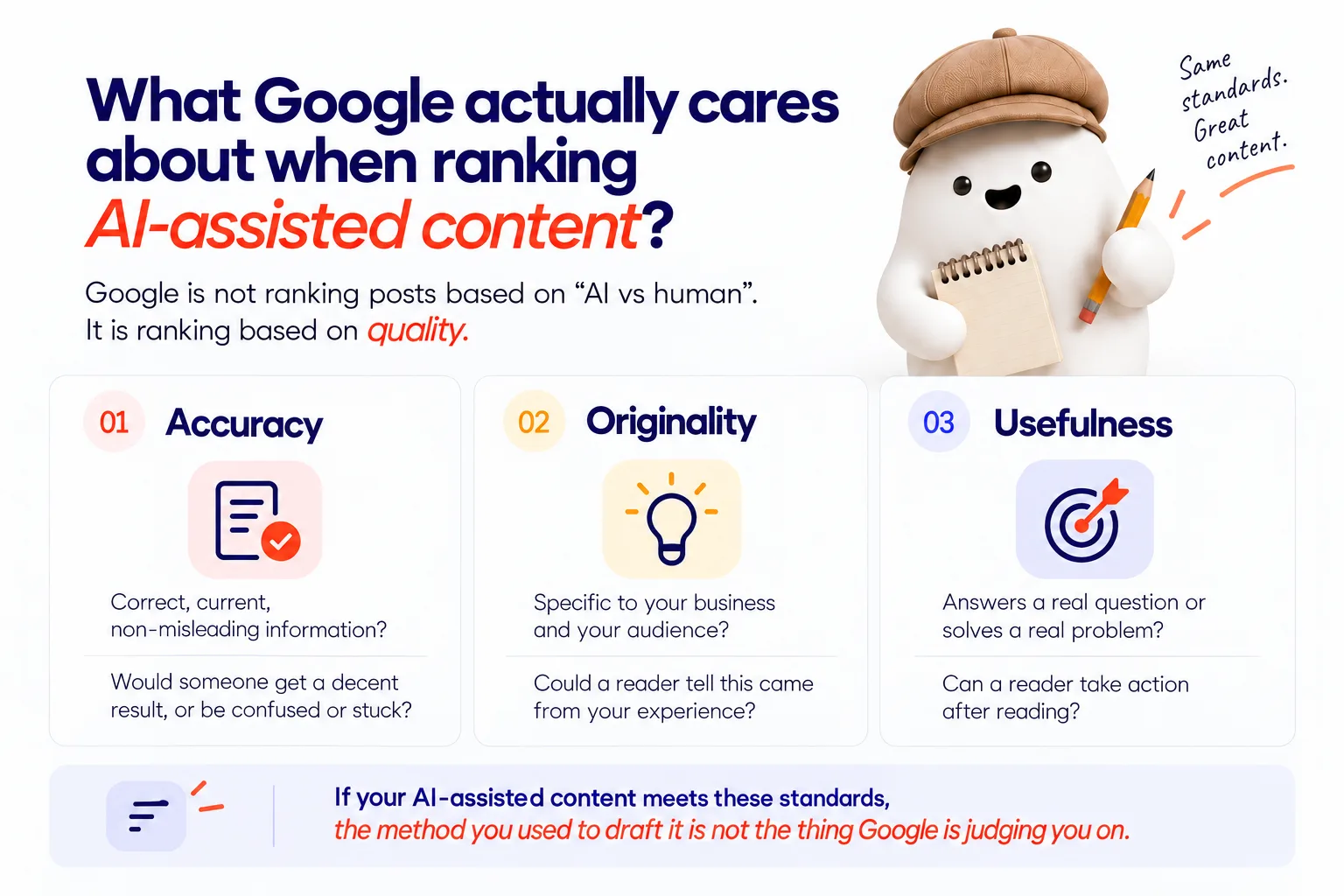
Google is not ranking posts based on “AI vs human”. It is ranking based on quality.
Carlos Silva of Semrush says AI-generated content can rank if it meets the same standards as strong human-written content: accuracy, originality and usefulness (source).
For you, that translates into a few practical questions for every post, no matter how it was drafted:
- Accuracy
Does this post give correct, current, non-misleading information? If someone followed the advice, would they get a decent result, or would they be confused or stuck?
- Originality
Does this say something specific to your business and your audience, or is it just a remix of common points? Could a reader tell this came from your experience, or would it look the same on any site in your niche?
- Usefulness
Does it answer a real question or solve a real problem, in a way that is concrete and easy to follow? Would a searcher feel they can take action after reading, or would they need to go back to Google and click something else?
If your AI-assisted content clears this bar, then the method you used to draft it is not the thing Google is judging you on.
This is where many AI-written blog posts fall down. Not because AI is “detectable”, but because:
- Facts are fuzzy or outdated.
- The angle does not quite match what the searcher wanted.
- The post never leaves the surface level.
So your job is not to hide AI. Your job is to guide and improve what AI gives you so it can meet the same standards as a good human post.
Why unedited AI posts struggle to rank (and sometimes backfire)?
Publishing raw AI drafts is where businesses get into trouble.
Here are the common failure points we see when posts are copied straight from an AI tool into your CMS.
1. They miss search intent
AI is good at writing “about” a topic, not at understanding what a searcher is really trying to do.
For example:
- The query might be “how to fix a leaky tap”, but the AI draft spends half the post explaining “what a tap is” and listing different types of taps.
- The search might be “pricing strategy for consultants”, but the draft lists definitions instead of walking through steps and examples.
When a post does not match intent, people click back quickly. Over time that hurts your ability to rank, regardless of how polished the wording is.
2. They repeat surface-level points
Most AI tools train on broad web content, so their default output often reads like an average of what is already out there.
The result:
- The same five tips everyone knows already.
- No specific examples from your niche or location.
- No “here is what actually works for our clients / our industry”.
In search results, that makes you very easy to skip. If the top ten posts all say the same thing, Google will favor the ones that show clearer expertise and depth.
3. They lack your real-world experience
Your advantage over AI is not grammar. It is context.
For instance:
- The questions your customers ask on sales calls.
- The mistakes they keep making before they find you.
- The language they use that never appears in generic posts.
AI does not see any of that unless you feed it in and then deliberately add to the draft. Without that, the post sounds detached from how your customers actually talk and decide.
4. They are more likely to contain quiet errors
AI tools can state things very confidently that are:
- Slightly wrong.
- Out of date.
- Right in theory but wrong for your specific audience or region.
On topics like money, law, health or safety, that is more than a minor inconvenience. It can erode trust with readers quickly.
5. They blur accountability
If you hit publish on a raw AI post and it contains a serious mistake, your readers do not blame the tool. They blame your brand.
That is why unedited AI is risky. Not only is it less likely to rank, it also shifts responsibility away from where it needs to be: with you or a specialist who can stand behind the content.
A safe way to use AI so your posts can actually rank
If raw drafts are risky, how do you use AI in a way that genuinely helps?
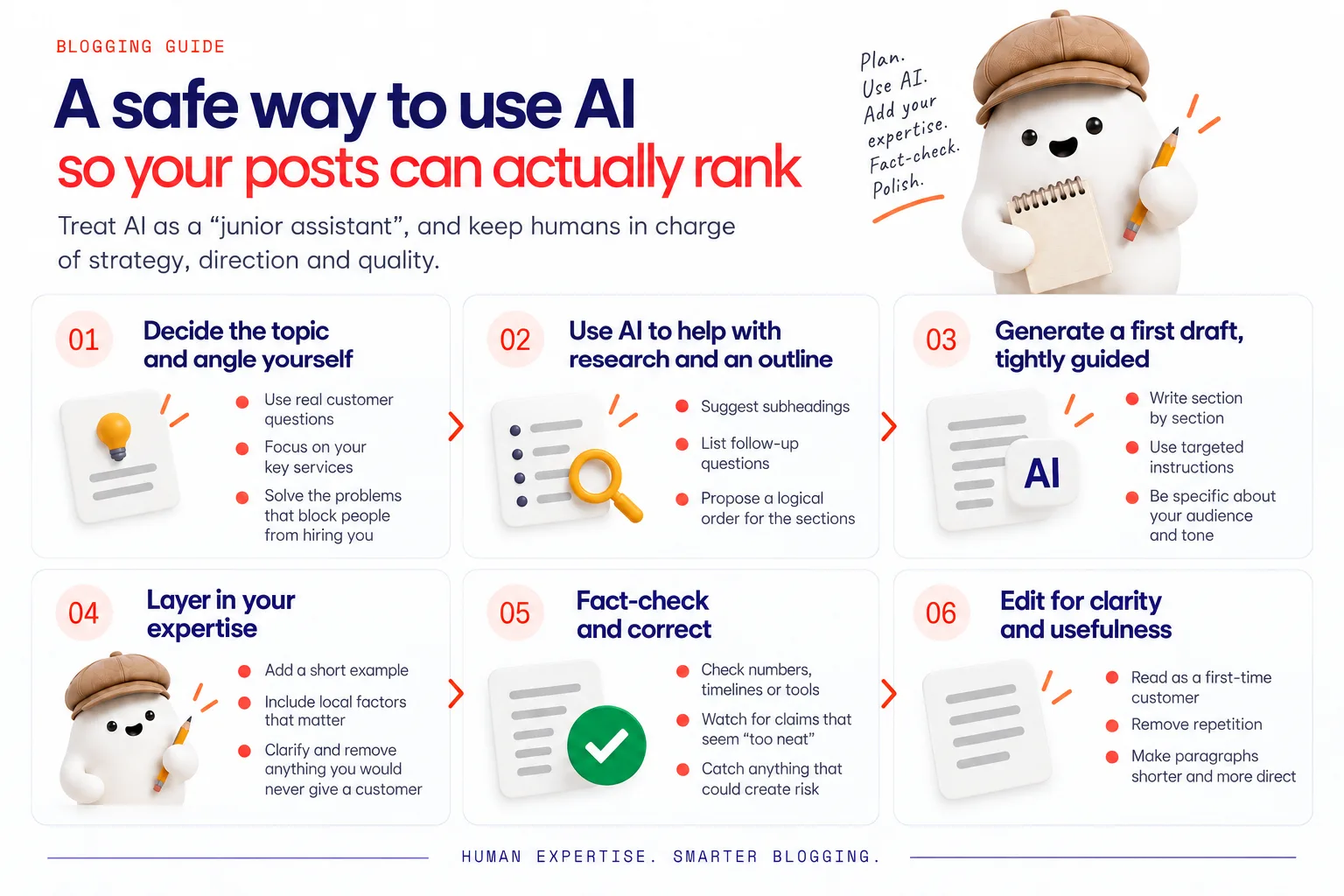
The answer is to treat AI as a “junior assistant”, and keep humans in charge of strategy, direction and quality.
Semrush’s AI-generated content guide says AI content can rank when humans oversee optimization, fact-checking and editing (source). That is the model we use.
Here is a simple, practical workflow you can follow without turning this into a second job.
Step 1: Decide the topic and angle yourself
Start with:
- The real questions customers ask you.
- The services that bring in your best clients.
- The problems that block people from hiring you.
Then write a short brief, for example:
“Write for homeowners who have a small but persistent roof leak. They are worried about cost and insurance. Explain options, give ballpark timelines, and show when they should call a professional.”
This keeps the post grounded in your business reality before AI ever touches it.
Step 2: Use AI to help with research and an outline
Next, ask the AI tool to:
- Suggest subheadings based on your brief.
- List follow-up questions people might have.
- Propose a logical order for the sections.
You might get something like:
- Causes of small roof leaks
- Temporary fixes you can do yourself
- When a roof leak is an emergency
- What a roofing contractor will check
- How long repairs usually take
You can then rearrange, delete or add based on what you know customers care about most.
Step 3: Generate a first draft, tightly guided
Once you are happy with the outline, you can have AI write section by section.
Instead of “Write 1,500 words about roof leaks”, give targeted instructions, for example:
- “Write 3 short paragraphs explaining the most common causes of small roof leaks in older houses. Avoid jargon. Aim at a worried homeowner who has never hired a roofer before.”
This usually gives you a clearer, more focused draft than a single giant prompt.
Step 4: Layer in your expertise
This is the part most people skip. It is also where your content becomes competitive.
For each section, ask yourself:
- Is there a story from a real client (anonymised) that would make this concrete?
- Are there local factors that matter? Climate, regulations, typical building types?
- Is there a “myths vs reality” gap you see all the time?
Then:
- Add a short example.
- Clarify anything that feels vague.
- Delete any advice you would never give a real customer.
Now the post is no longer generic AI output. It is your experience, structured more quickly with AI’s help.
Step 5: Fact-check and correct
Do a quick but focused check on:
- Any numbers, timelines or named tools.
- Any claims that sound like they might be “too neat” or overgeneralised.
- Any advice that could create risk if someone follows it literally.
You do not have to audit every word, but you do need to catch the things that would make you uncomfortable to say out loud.
Step 6: Edit for clarity and usefulness
Finally, read the post as if you were a customer landing on your site for the first time.
Ask:
- Do I know what to do next?
- Are there sections that repeat themselves?
- Can any paragraph be shorter or more direct?
This is also where you tidy headings, add calls to action and make sure the post flows.
If this still feels like a lot to juggle, working with a specialist-led system (like our Fasta Blogging automated SEO blog assistant) means this workflow is built in for you, rather than one more process to manage.
Can you get results from AI-assisted posts? (Real example)
Theory is one thing. Results are what matter.
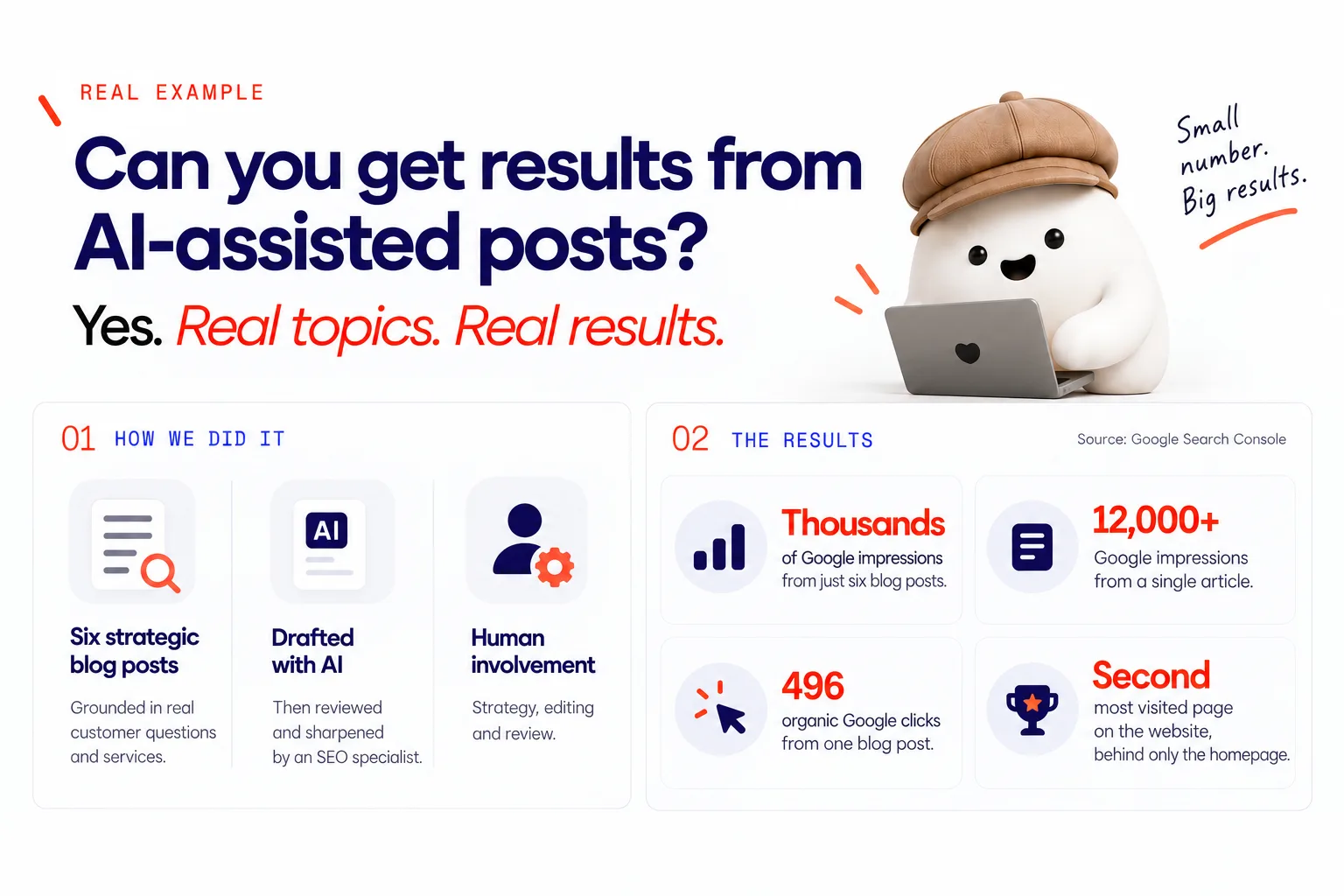
Using a human-guided, AI-assisted blogging process, we worked on a site where:
- Using this strategy, we published just six strategic blog posts.
- Those posts were grounded in real customer questions and services, not random AI topics.
- The content was drafted with AI, then reviewed and sharpened by an SEO specialist.
From there, the outcomes were clear (source: Google Search Console):
- 12,000+ Google impressions from a single article.
- 496 organic Google clicks from one blog post.
- One blog post became the second most visited page on the website, behind only the homepage.
These results did not come from “AI content” on its own. They came from combining:
- A small number of well-chosen topics.
- AI to accelerate the drafting.
- Human strategy, editing and review.
If you want to see how this kind of approach has played out in other cases, you can explore more on our Results page.
How to decide when to use AI vs write or outsource manually?
You do not need to use AI for every post. In fact, there are situations where a fully human process is the better choice.
Here is a simple way to decide.
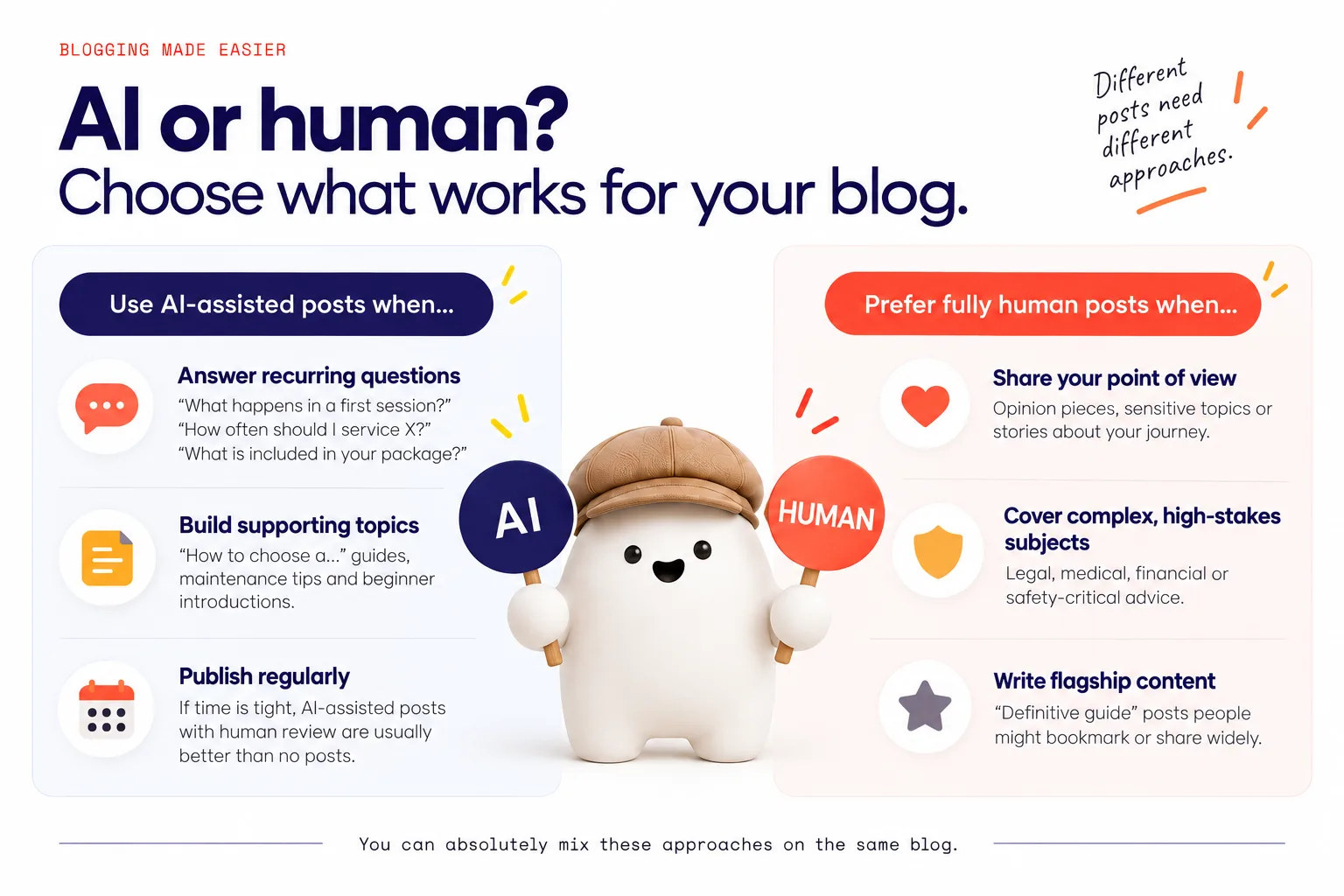
Use AI-assisted posts when…
AI-assisted posts work well for consistent, educational content, especially when:
- You are answering recurring customer questions
“What happens in a first session?”, “How often should I service X?”, “What is included in your package?” These benefit from clear explanations and can follow a repeatable structure.
- You are building out supporting topics around your main services
Think “how to choose a…” guides, maintenance tips and beginner introductions that help people feel ready to contact you.
- You need to publish regularly, but time is tight
If the choice is between “no posts” and “AI-assisted posts with human review”, the second option usually wins over silence.
Prefer fully human (or specialist-written) posts when…
- You are sharing a strong personal or brand point of view
Opinion pieces, sensitive topics or stories about your journey land best in your own voice, without an AI first draft.
- You are covering complex, high-stakes subjects
Anything involving legal, medical, financial or safety-critical advice deserves a human expert from the start.
- You are writing flagship content
This is the “definitive guide” people might bookmark or share widely. Here, you may still use AI for research support, but the core thinking should be human.
You can absolutely mix these approaches on the same blog. Many businesses use AI-assisted posts for their steady drumbeat of educational content, and reserve manual effort for their most important pieces.
Ethics and transparency: is it okay to publish AI-assisted content?
There is a separate question from rankings: should you use AI at all?
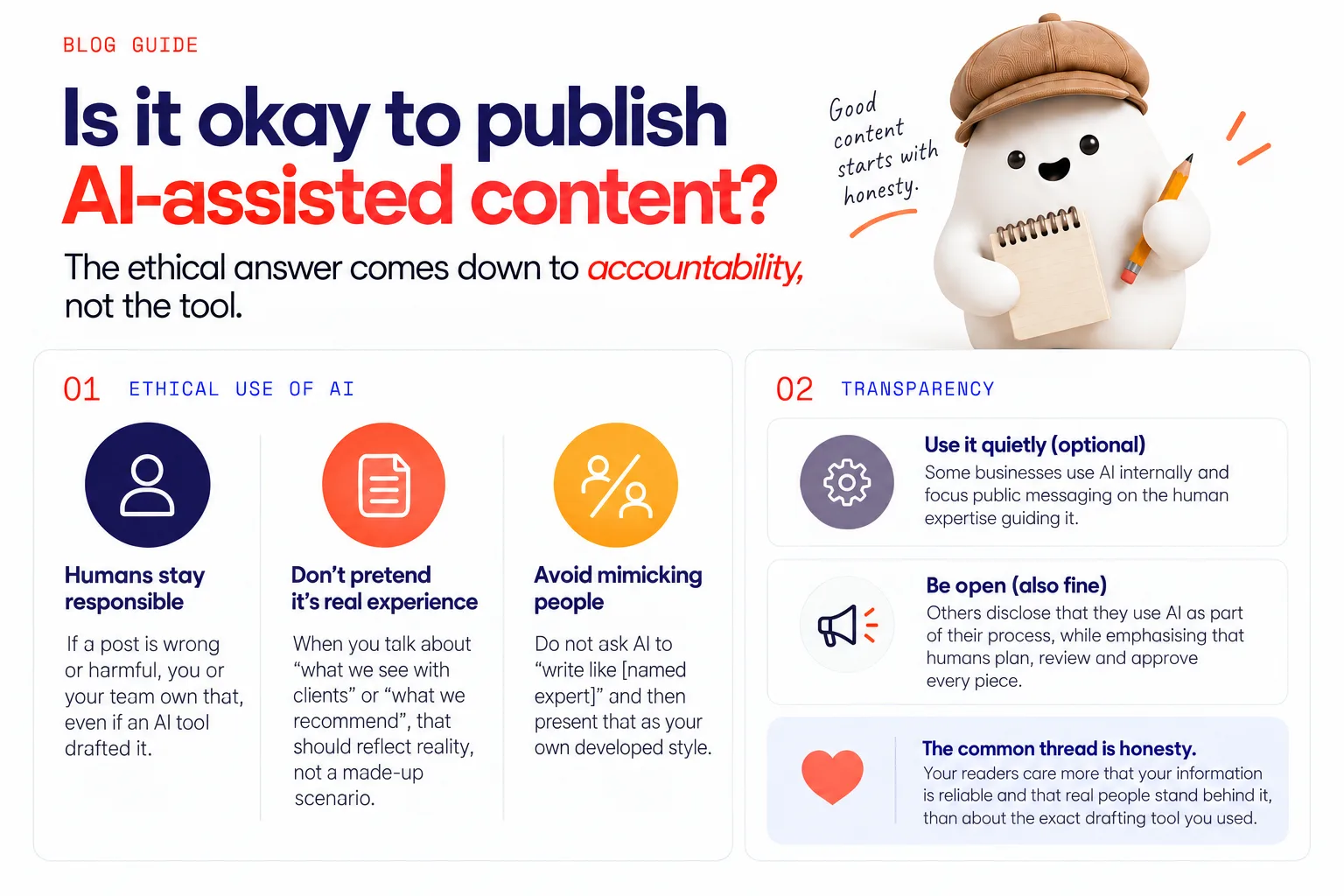
The ethical answer comes down to accountability, not the tool.
Ethical use of AI means:
- Humans stay responsible for accuracy and impact
If a post is wrong or harmful, you or your team own that, even if an AI tool drafted it.
- You do not pretend AI’s output is your lived experience
When you talk about “what we see with clients” or “what we recommend”, that should reflect reality, not a made-up scenario.
- You avoid using AI to mimic people without consent
For example, do not ask AI to “write like [named expert]” and then present that as your own developed style.
On transparency, there is more than one acceptable approach:
- Some businesses quietly use AI as an internal tool and focus their public messaging on the human expertise guiding it.
- Others disclose that they use AI as part of their process, while emphasising that humans plan, review and approve every piece.
The common thread is honesty. Your readers care more that your information is reliable and that real people stand behind it, than about the exact drafting tool you used.
If you want AI-written posts that can rank without becoming tech homework
You do not need to become an AI prompt engineer, a full-time editor and an SEO specialist on top of running your business.
At Fasta Blogging, we built our system for owners who want the benefits of AI-assisted blogging, without the risk of “copy, paste and hope”.
- Your blogging is handled each month, planned with an SEO specialist.
- Drafts are created with automation to save time, then reviewed by a human before they are ready.
- Posts are written in your voice, based on your real services and customers.
If you would like that kind of “handled for you” version of everything in this article, you can learn more at Fasta Blogging.
FAQs
Will Google penalize AI-written blog posts?
Google does not have a blanket penalty for AI-written posts. What causes problems is low-quality content, regardless of how it was drafted. If an AI-written post is inaccurate, unoriginal or unhelpful, it is less likely to rank and more likely to hurt trust. If it meets strong standards, AI involvement on its own is not the issue.
Do AI-assisted blog posts need human editing to rank?
They do not technically “need” human editing to be indexable, but in practice, human editing makes a big difference. Semrush’s study found that content classified as purely AI-generated appeared in the top spot just 9% of the time (source), and Carlos Silva of Semrush says AI-generated content can rank if it meets the same standards as strong human-written content: accuracy, originality and usefulness (source). A human review is usually what turns a generic draft into a competitive article.
When should I use AI for blogging instead of writing manually?
Use AI when you know what you want to say, but you need help getting it onto the page faster, especially for repeatable educational topics and common customer questions. Write manually, or work closely with a human specialist, for complex, sensitive or flagship content where nuance and your personal experience matter most.
Is it ethical to publish AI-assisted content?
Yes, it can be ethical to publish AI-assisted content as long as humans stay accountable for what is published. That means checking accuracy, grounding posts in real expertise, and not using AI to misrepresent who you are or what you know. Many businesses now use AI as a behind-the-scenes assistant, while keeping humans in charge of judgment and integrity.
See us more often on Google
Add Fasta Blogging as a preferred source and our posts show up higher in your results.
Add as preferred sourceScore your blog
Paste one post and see how it measures up on structure, search and readability.
Get your free scoreNo account needed
Or skip the check and have us write them — start blogging.
$125/mo · cancel anytime