Table of contents
- How boudoir clients use Google and where your blog fits
- The 4 boudoir blog posts you should be posting
- 1. Session stories (with consent)
- 2. Location and studio guides
- 3. Prep and how-it-works guides
- 4. Myth-busting posts that calm nerves
- How to choose your next boudoir blog post
- Consent, privacy and safety when you use real sessions
- From shoot to blog: a consent-safe checklist
- How to structure a boudoir blog post
- How often should boudoir photographers blog?
- Using AI safely in your boudoir blogging
- How to tell if your boudoir blog is working
- Make blogging a simple system, not another chore
- FAQs
- What should a boudoir photographer blog about for SEO?
- How do I blog boudoir sessions without compromising client privacy?
- How often should a boudoir photographer blog?
- Can AI help with boudoir SEO blogging?
Summary: SEO blogging for boudoir photographers means answering the exact questions nervous clients are already Googling, with real sessions, locations, and advice. When you build a simple, repeatable system that protects privacy, those posts can help you show up locally and turn readers into confident inquiries.
If you are a boudoir photographer then SEO and blogging should be a part of your marketing strategy. It is a simple and affordable way to answer client questions, feature the work you already do, and help Google And AI understand who you are and where you are. In this guide, we will keep everything practical, low tech, and privacy-aware. You will leave with a repeatable workflow you can run yourself or hand off to a tool when you are ready.
How boudoir clients use Google and where your blog fits
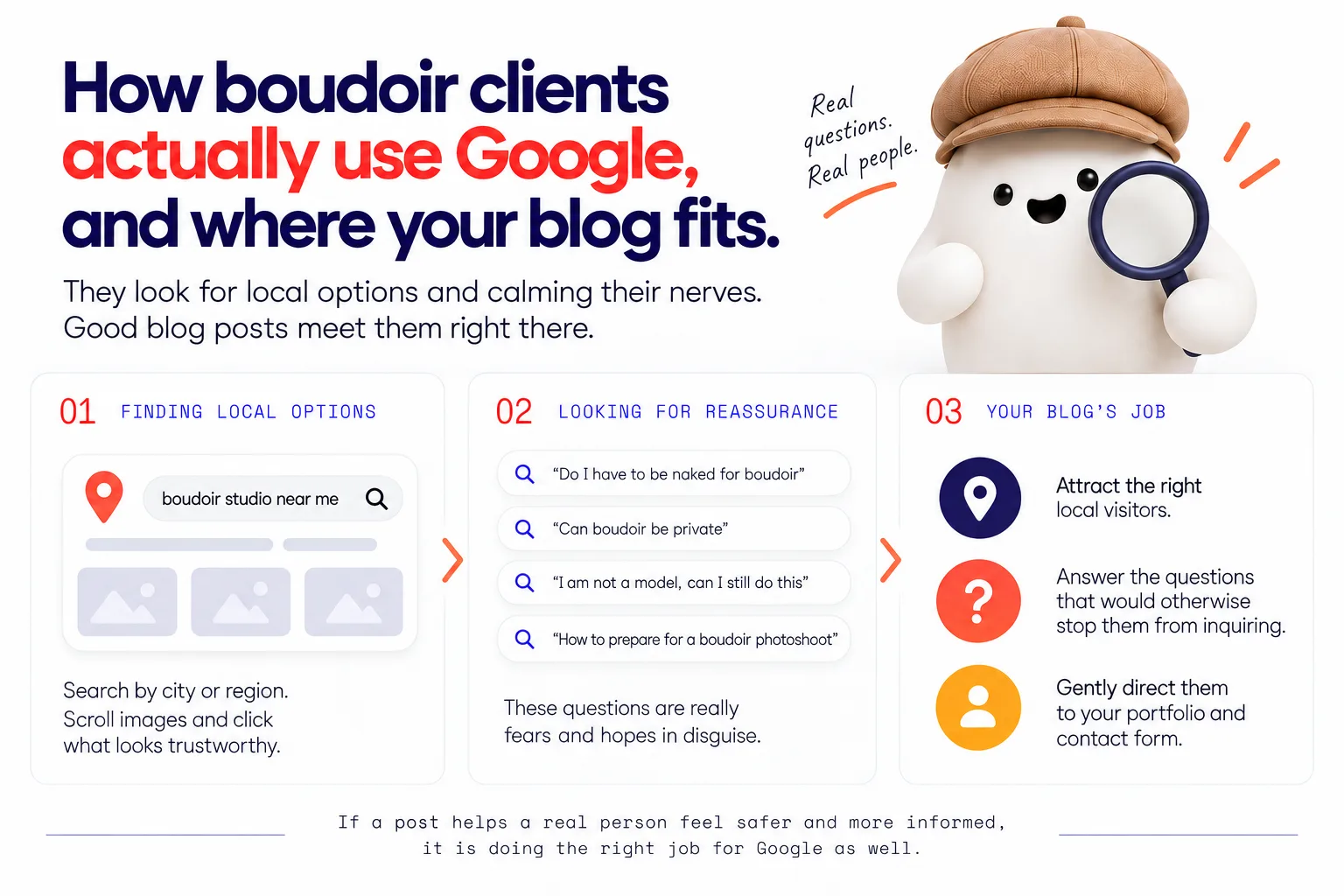
Boudoir feels vulnerable, so most people use Google and Ai search for two things: finding local options and calming their nerves.
First, they look for studios near them. They search by city or region, scroll image results, and click anything that looks trustworthy. If your posts talk clearly about your locations and service area, you give Google more chances to show you for those local searches.
Second, they look for reassurance. The questions they type are really fears and hopes in disguise:
- “Do I have to be naked for boudoir”
- “Can boudoir be private”
- “I am not a model, can I still do this”
- “How to prepare for a boudoir photoshoot”
Good blog posts meet them right there.
Google’s helpful-content guidance supports exactly this kind of blogging. It favors content that is genuinely useful and specific, such as real sessions, real locations, preparation advice, and real client questions, rather than generic filler stuffed with keywords.
Your blog’s job is to:
- Attract the right local visitors.
- Answer the questions that would otherwise stop them from inquiring.
- Gently direct them to your portfolio and contact form when they are ready.
If a post helps a real person feel safer and more informed, it is doing the right job for Google as well.
The 4 boudoir blog posts you should be posting
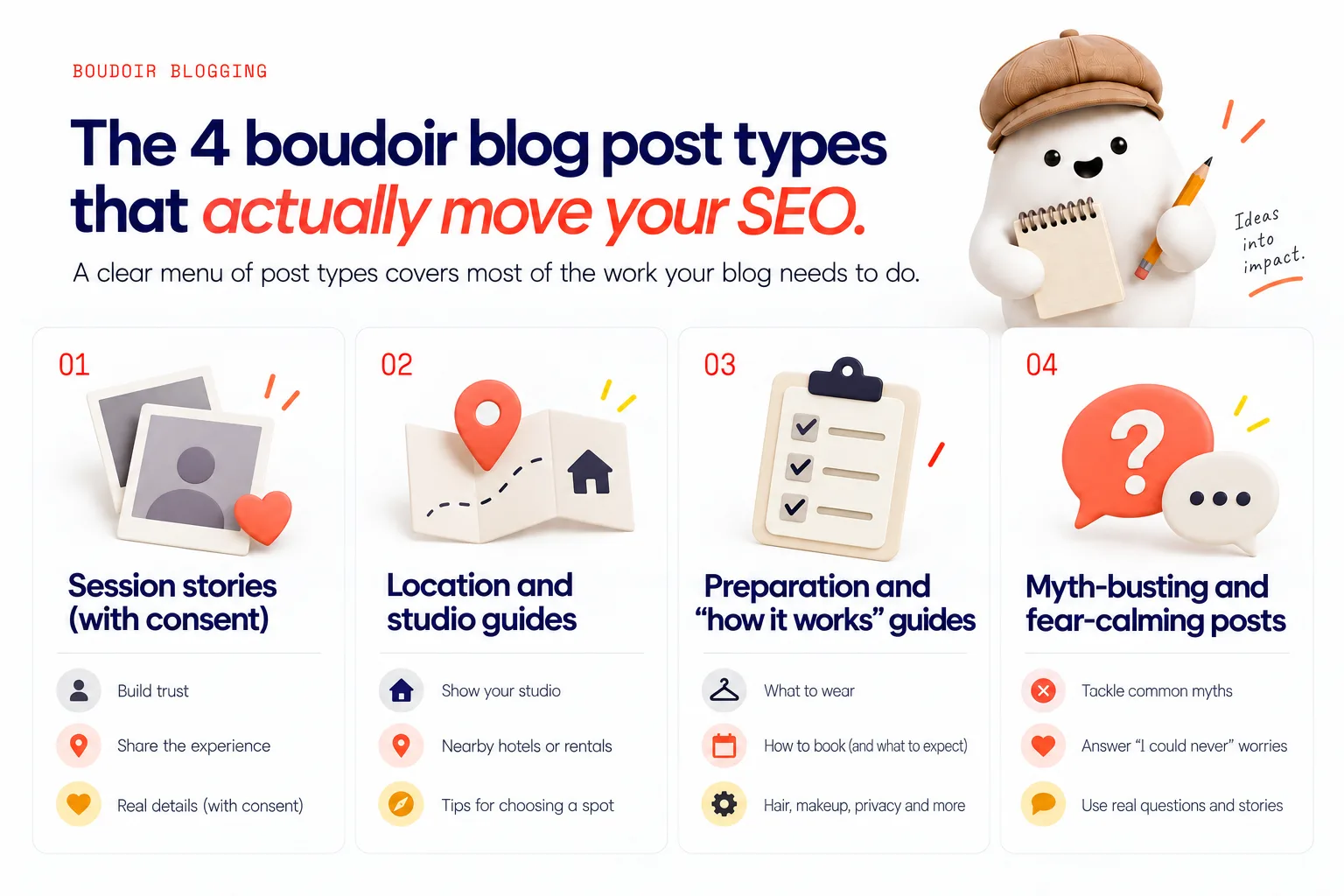
When you have a clear menu of post types, you are never staring at a blank page. These four types cover most of the work your blog needs to do.
1. Session stories (with consent)
Session stories are your most powerful trust builders, as long as they are framed around experience, not just as image dumps.
A strong session story focuses on:
- The client’s reason for booking (anniversary, wedding, confidence, life change, just because).
- The location (studio, hotel, outdoor spot) and why it worked.
- Their main worry going in and how you handled it.
- What the session actually felt like, in human language.
- One or two specific details that make it memorable.
You can write session stories with:
- Full face and name (when clients are thrilled to share).
- Partially anonymized details (initials only, close crops).
- No identifying images at all, focusing on the story and non-face shots.
From an SEO perspective, session stories help when you naturally mention your city, nearby neighborhoods, and types of spaces you shoot in. From a client’s perspective, they help her see someone “like her” doing this and surviving.
2. Location and studio guides
Location guides help you show up when people search for “boudoir photos [city]” or “boudoir studio near [neighborhood]”.
These posts can cover:
- Your main studio: what it looks like, the lighting, sets, and vibe.
- Favorite nearby hotels or rental spaces you regularly shoot in.
- General guidance on choosing a location for a boudoir session in your region.
Instead of sounding like a tourist brochure, write like a photographer:
- What time of day the light is best.
- Where clients can change comfortably.
- How private the space is and why nervous beginners like it.
- How close it is to major landmarks or neighborhoods.
When we write location content, we focus on how someone would actually pick a spot for intimate photos, not just where it sits on a map.
3. Prep and how-it-works guides
Prep posts answer the questions someone has before they will even consider booking. They also give you a natural place to use the phrases people type when they are in research mode.
Classic topics:
- What to wear for a boudoir session in [season or city].
- How far in advance to book.
- Hair and makeup: what you provide, what they should plan.
- What really happens during a session, step by step.
- How you handle image privacy and delivery.
These posts do double duty. They reduce pre-session email back-and-forth, and they help people who are not ready to inquire yet find you early.
4. Myth-busting posts that calm nerves
Boudoir attracts myths and “I could never” stories. Posts that tackle those head on can earn search traffic and build connection with people who are secretly curious.
Examples:
- “You do not need to lose 10 pounds first: how we pose and light real bodies.”
- “You can have a private boudoir experience, even if no one ever sees the photos.”
- “I am not a model: what ‘looking good on camera’ really means in boudoir.”
These posts work best when you:
- Use direct, conversational language.
- Share snippets from real sessions or common questions you hear.
- Link clearly to your contact page for anyone who feels ready.
You can see an example of a myth-busting post in our own work in the SEO blog post examples and writing samples.
How to choose your next boudoir blog post
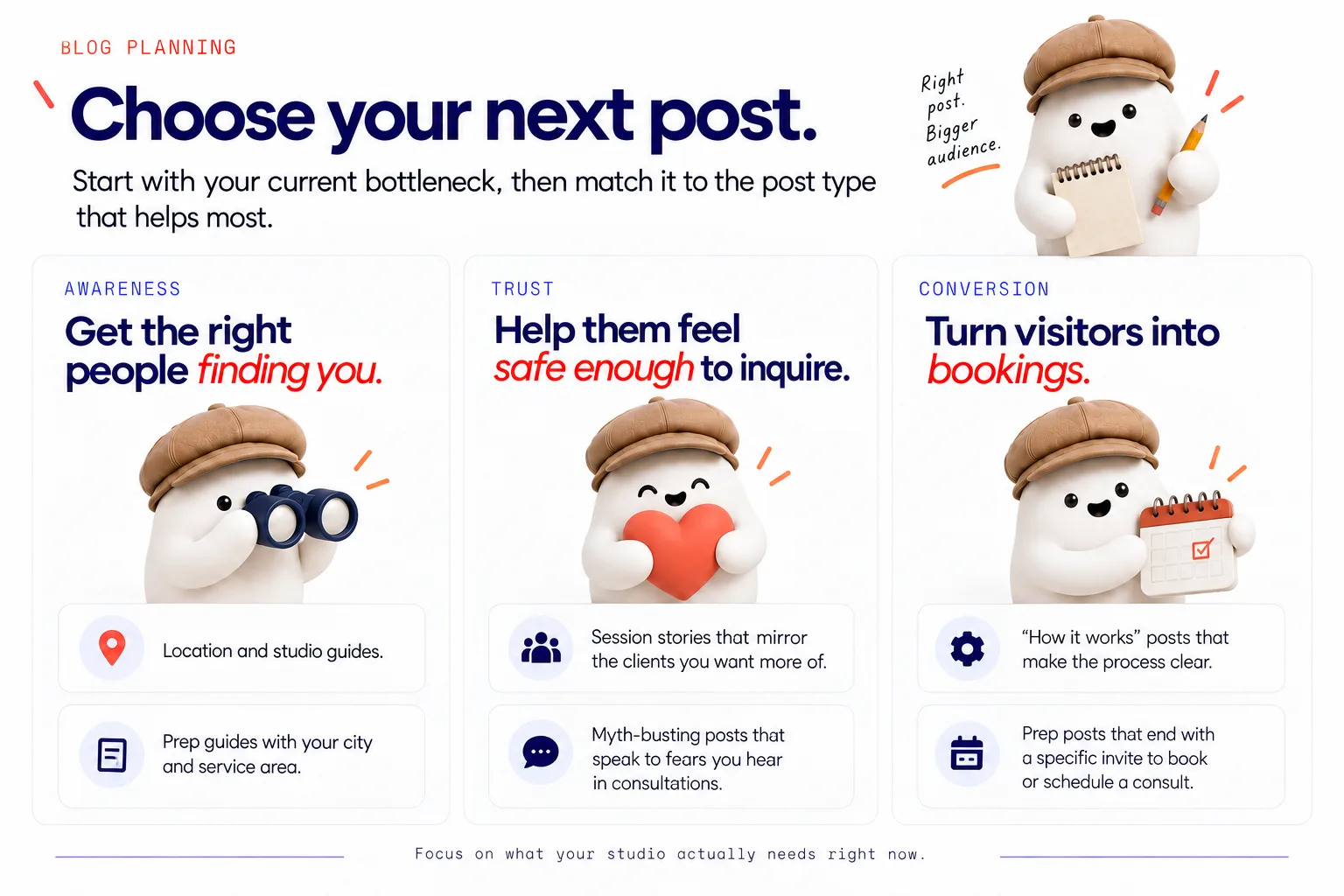
To decide what to blog next, start with your current bottleneck: awareness, trust, or conversion. Then match it to the post type that helps most.
If your bottleneck is awareness, you need more of the right people finding you in the first place. Prioritize:
- Location and studio guides.
- Prep guides that include your city and service area in natural ways.
If your bottleneck is trust, people are finding you but not feeling safe enough to inquire. Prioritize:
- Session stories that mirror the clients you want more of.
- Myth-busting posts that speak to fears you hear in consultations.
If your bottleneck is conversion, visitors land on your site but do not take the next step. Prioritize:
- “How it works” posts that make the process crystal clear.
- Prep posts that end with a specific invite to book or schedule a consult.
When we plan content for photographers, this bottleneck check is the first filter. It keeps your efforts lined up with what your studio actually needs right now, rather than random topics you feel like writing.
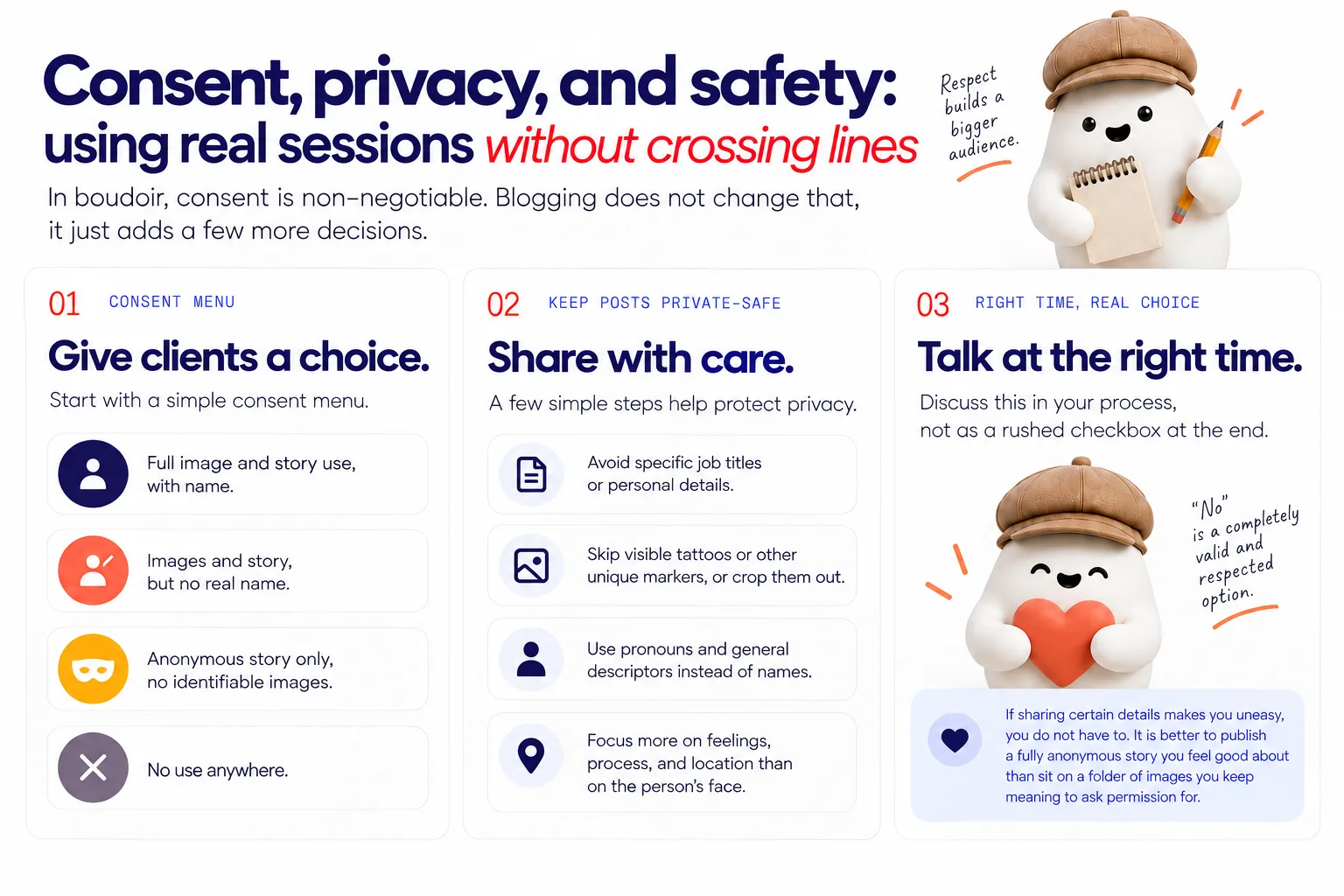
Consent, privacy and safety when you use real sessions
In boudoir, consent is non-negotiable. Blogging does not change that, it just adds a few more decisions.
Start by building a simple consent menu that clients can choose from. For example:
- Full image and story use, with name.
- Images and story, but no real name.
- Anonymous story only, no identifiable images.
- No use anywhere.
Talk through this at the right time in your process, not as a rushed checkbox at the end. Reassure clients that “no” is a completely valid and respected option.
To keep posts privacy-safe, you can:
- Avoid specific job titles or personal details that could identify someone.
- Skip visible tattoos or other unique markers, or crop them out.
- Use pronouns and general descriptors instead of names.
- Focus more on feelings, process, and location than on the person’s face.
Be honest with yourself too. If sharing certain details makes you uneasy, you do not have to. It is better to publish a fully anonymous story you feel good about than sit on a folder of images you keep meaning to ask permission for.
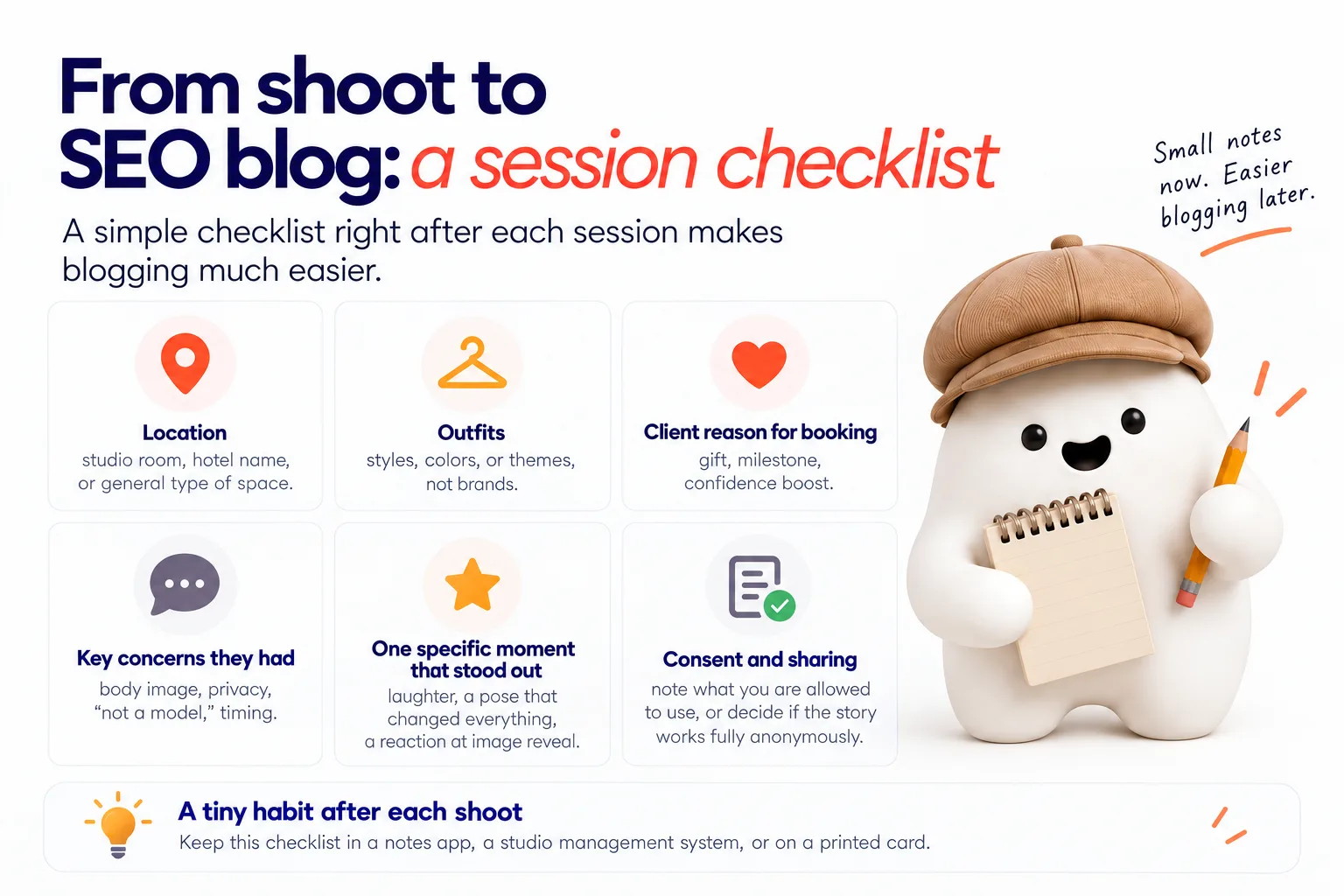
From shoot to blog: a consent-safe checklist
A simple checklist right after each session makes blogging much easier. You do not need to remember everything months later.
Right after a session, while it is fresh, jot down:
- Location: studio room, hotel name, or general type of space.
- Outfits: styles, colors, or themes, not brands.
- Client reason for booking: gift, milestone, confidence boost.
- Key concerns they had: body image, privacy, “not a model,” timing.
- One specific moment that stood out: laughter, a pose that changed everything, a reaction at image reveal.
If you have consent for some level of sharing, note what you are allowed to use. If not, decide whether this story still works in a fully anonymous way.
You can keep this checklist in a notes app, a studio management system, or on a printed card. The goal is a tiny habit you run after each shoot, not a big project.
Later, when you (or a tool like Fasta Blogging) sit down to write, you already have the raw material that matters to both nervous clients and search engines.
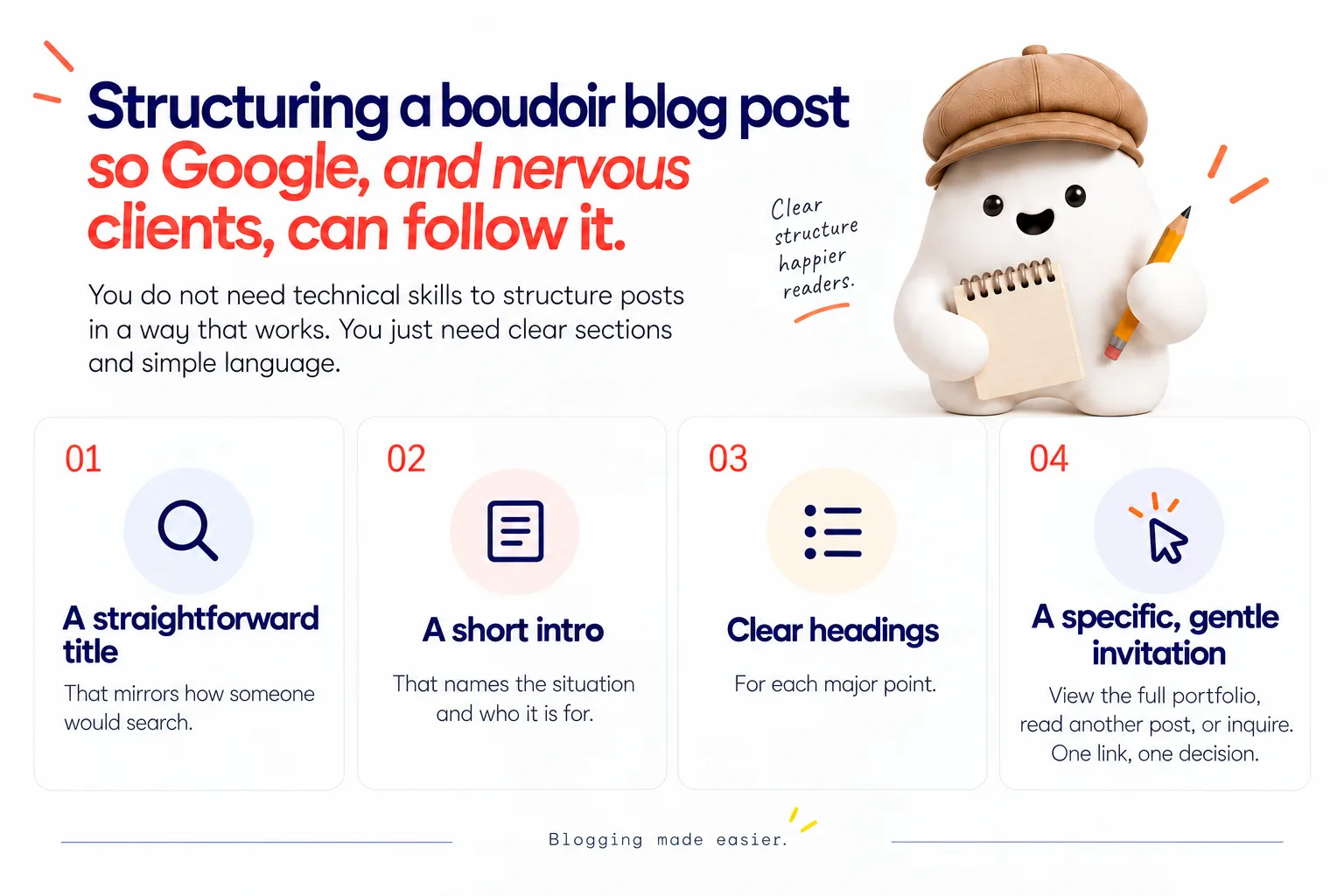
How to structure a boudoir blog post
You do not need technical skills to structure posts in a way that works. You just need clear sections and simple language.
A basic structure you can reuse:
- A straightforward title that mirrors how someone would search.
- A short intro that names the situation and who it is for.
- Clear h2 headings for each major point.
- A specific, call to action (CTA) at the end.
Clear, descriptive headings that echo how clients search help both readers and search. For example:
- “What to wear for a boudoir photoshoot in [city]”
- “Is my boudoir session private”
- “Boudoir photos at [hotel or neighborhood]”
Under each heading, answer the question in the first sentence. Then add one or two supporting paragraphs with concrete details.
Make sure you include images, use the text around them to explain what is happening in the photo, where it is, and why it matters. Google’s SEO starter guide notes that text around images helps search engines understand what the image shows and how it relates to the page, which is exactly what you want here. Make sure you o ptimize your images for SEO as well. That means reformatting them to JPEG or WebP, resizing them to a better size (generally smaller than 3000px), renaming and adding alt text for all of them.
Link to other blog posts you have and pages on your website. This is called internal linking and is very important. Also add a title and meta description. The title will be the blog title. The meta description you write. No keyword stuffing, and definitely no adding keywords and putting them in white text. So many photographers still try this technique, and Google knows what you are doing. It does not help you, in fact it will likely hurt you.
End each post with one clear next step: view the full portfolio, read another post, or inquire. One link, one decision.
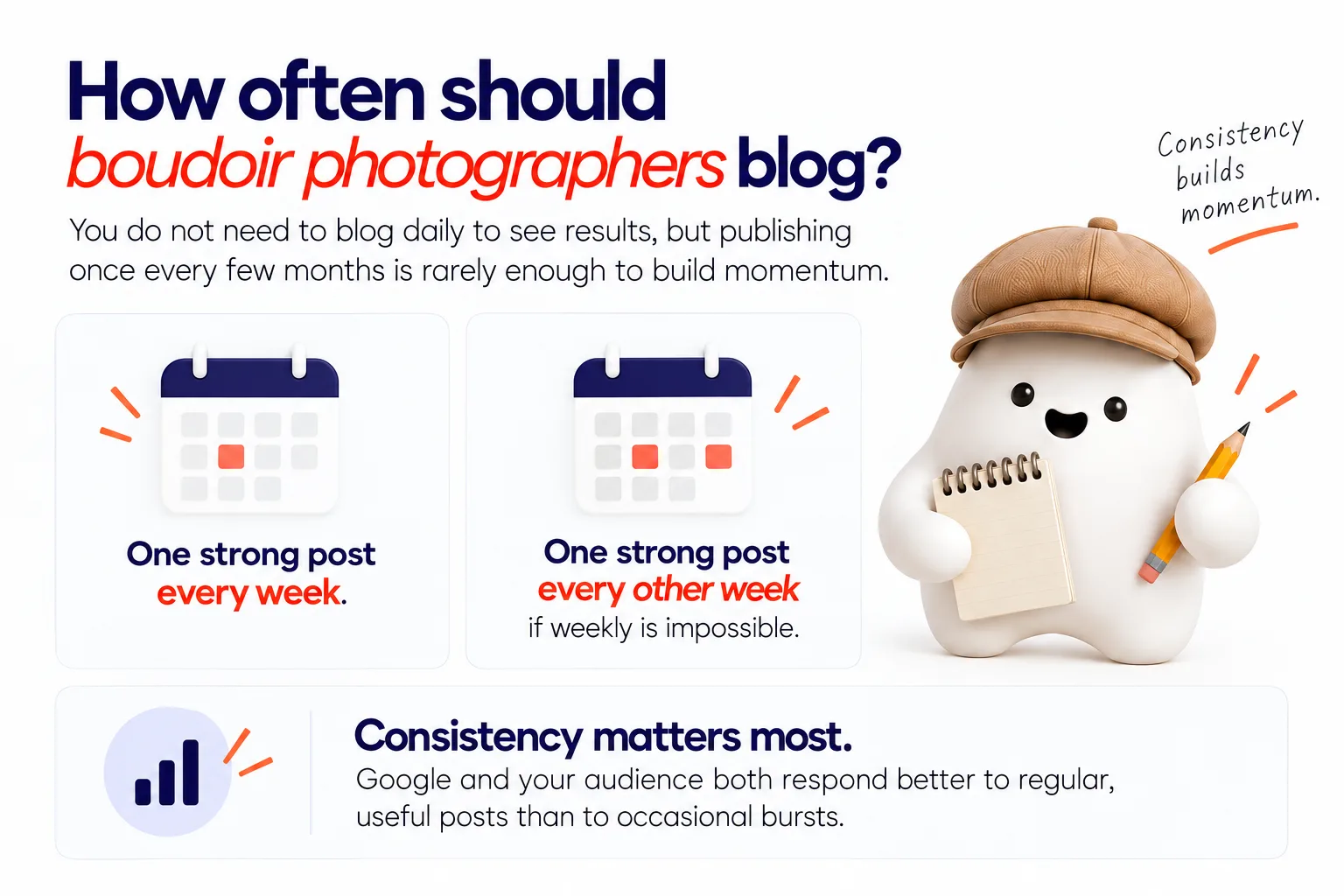
How often should boudoir photographers blog?
You do not need to blog daily to see results, but publishing once every few months is rarely enough to build momentum.
High-volume blogging can speed things up, but it is usually unrealistic for a solo boudoir photographer who is also shooting, editing, and handling inquiries. Instead, pick a cadence you can actually sustain for six months.
For many studios, that looks like:
- One strong post every week.
- Or one strong post every other week if weekly is impossible.
According to HubSpot’s marketing statistics, website, blog and SEO remain the number one ROI-generating channel for marketers. That matters for boudoir, where you want marketing that works quietly in the background, even when you are not on social media.
What matters more than perfection is consistency. Google and your audience both respond better to regular, useful posts than to occasional bursts.
This is also why we built Fasta Blogging to deliver a new post every week with around 20 minutes of your time. If writing is the bottleneck but you want the results of consistent publishing, that kind of support can bridge the gap.

Using AI safely in your boudoir blogging
AI tools can help with content, but they are not a magic switch you flip and forget.
Google’s guidance on AI content says AI content is not automatically disallowed, but automation used mainly to manipulate rankings is a problem. That supports using AI only when the post still reflects your real expertise and adds value.
In practice, that means:
- You provide the real stories, locations, and client questions.
- AI helps shape drafts or structure, but you review every word.
- You do not publish generic, unedited AI copy on sensitive topics like intimacy and bodies.
Semrush’s survey of SEO teams found that 87% of SEO teams report that their content is either fully created by humans or heavily led by humans, keeping humans directly involved in production and editing. The professionals keeping an eye on results still keep people in the loop.
Our own approach follows that pattern. Fasta Blogging is built by an SEO specialist, and we keep you, the photographer, at the center. You bring the consent level, stories, and preferences, we handle strategy and drafting, and nothing goes live without sounding like you.
If you are using AI on your own, a simple rule helps: if your best friend read this post, would she recognize your studio in it, or could it belong to anyone. If it is the second, it needs more of your voice and real detail.
If you want to dive deeper into how AI content can perform when it is guided and edited, you can read our take in Can AI-Written Blog Posts Rank on Google?.
How to tell if your boudoir blog is working
You do not need advanced analytics to see if your blogging is paying off. A few simple checks every month will tell you a lot.
Track three basics:
- Which posts bring in organic search traffic.
- Which phrases those posts show up for.
- Whether visitors click through to your inquiry or portfolio pages.
Using this strategy, we published just six strategic blog posts for a client. Already those articles have generated 12,000+ Google impressions from a single article, 496 organic Google clicks from one blog post, a blog post that became the second most visited page on the website behind only the homepage, and multiple articles beginning to rank for valuable local searches.
If you want more precise data, free tools like Google Search Console and Google Analytics can show you impressions, clicks, and top-performing pages. Our own performance reporting connects those same tools so we can see how blog posts are doing over time.
You can also run your existing posts through the Free Blog Post SEO Checker to get a score out of 100 and see your top fixes for a single article at a time.
The goal is not to watch numbers every day. It is to notice which topics and formats seem to attract searchers and inquiries, so you can do more of what works.
Make blogging a simple system, not another chore
To keep this sustainable, think in terms of a loop you run, not isolated heroic efforts.
The loop looks like this:
- Choose the right post type, based on your bottleneck: awareness, trust, or conversion.
- Use your post-session checklist to collect story details and consent.
- Structure the post with a clear title, headings, and one next step.
- Publish on a regular cadence you can stick to.
- Check basic results every month and adjust topics based on what is working.
Some photographers love writing and run this system themselves. Others would rather spend that time shooting and serving clients.
That is why we built how Fasta Blogging works for photographers around a simple promise: your blogging handled each month, planned with an SEO specialist and written in your voice. Before Fasta Blogging, Caitlin charged $250 per blog post. Now, for $125 a month, you get SEO strategy, your voice, and a new post every week, in around 20 minutes of your time.
If you want expert guidance to identify what is holding your website back and shape your blogging strategy, we include that as part of working with us.
FAQs
What should a boudoir photographer blog about for SEO?
Blog about real sessions, locations you shoot in, preparation and process, and the fears and myths your clients bring up. Use your city and region in titles and headings where it fits naturally. Focus on posts that would genuinely help a nervous potential client make a decision.
How do I blog boudoir sessions without compromising client privacy?
Start with clear consent options and honor “no.” Use anonymous stories, non-identifying crops, or no images at all if needed. Avoid specific personal details, and focus on feelings, process, and locations instead of faces and names.
How often should a boudoir photographer blog?
Aim for at least one strong post every month, and ideally one every week or every other week. Choose a pace you can sustain for six months so your blog stays active and builds momentum.
Can AI help with boudoir SEO blogging?
Yes, as long as it supports your real expertise instead of replacing it. Use AI to help shape drafts or structure, then edit closely so posts reflect your voice, consent boundaries, and client experience.
If you want this whole system handled for you, from strategy to weekly posts in your voice, you can work with Fasta Blogging, our automated SEO blog assistant for photographers.
Roast your blog post
Paste one post and get honest feedback on structure, search and readability.
Get your free roastNo account needed
Or skip the roast and have us write them: start blogging.
$125/mo · cancel anytime