Table of contents
- Start with the real answer: how often should a small business blog?
- Why consistency over time beats short bursts of blogging
- How to choose your starting blog frequency
- 1. Count your real available time
- 2. Factor in your budget and support
- 3. Align with your goals and timeline
- 4. Pick a number you are 90% sure you can keep
- What changes when you blog weekly? (or more often)
- How much blogging is “enough” to see results?
- Turn your target frequency into a real monthly plan
- Step 1: Fix your publishing days
- Step 2: Assign themes to each slot
- Step 3: Batch your planning, not your publishing
- Step 4: Protect one recurring “blogging block”
- Adjusting your blogging cadence based on results
- When to get help with blogging frequency
- FAQ: quick answers about blog post frequency
- What if I miss a scheduled post?
- Is it bad for SEO to post multiple times in one day or batch-upload posts?
- How should seasonal businesses handle blogging cadence?
- Can my blogging frequency change over time?

Summary: Start with 2–4 blog posts per month and focus on keeping that going for at least six months. Increase toward weekly only when you can sustain it without sacrificing quality.
Blogging can bring in leads, Google visibility, and trust, but the “How often should I post?” question stalls a lot of small businesses. You do not need to publish every day, and you do not need a content team to see results. You do need a realistic schedule that fits your life, and a plan you can stick to when work gets busy. In this post, we will walk through how often to publish, why consistency matters more than volume, and how to turn a target cadence into a simple plan you can actually follow.
Start with the real answer: how often should a small business blog?
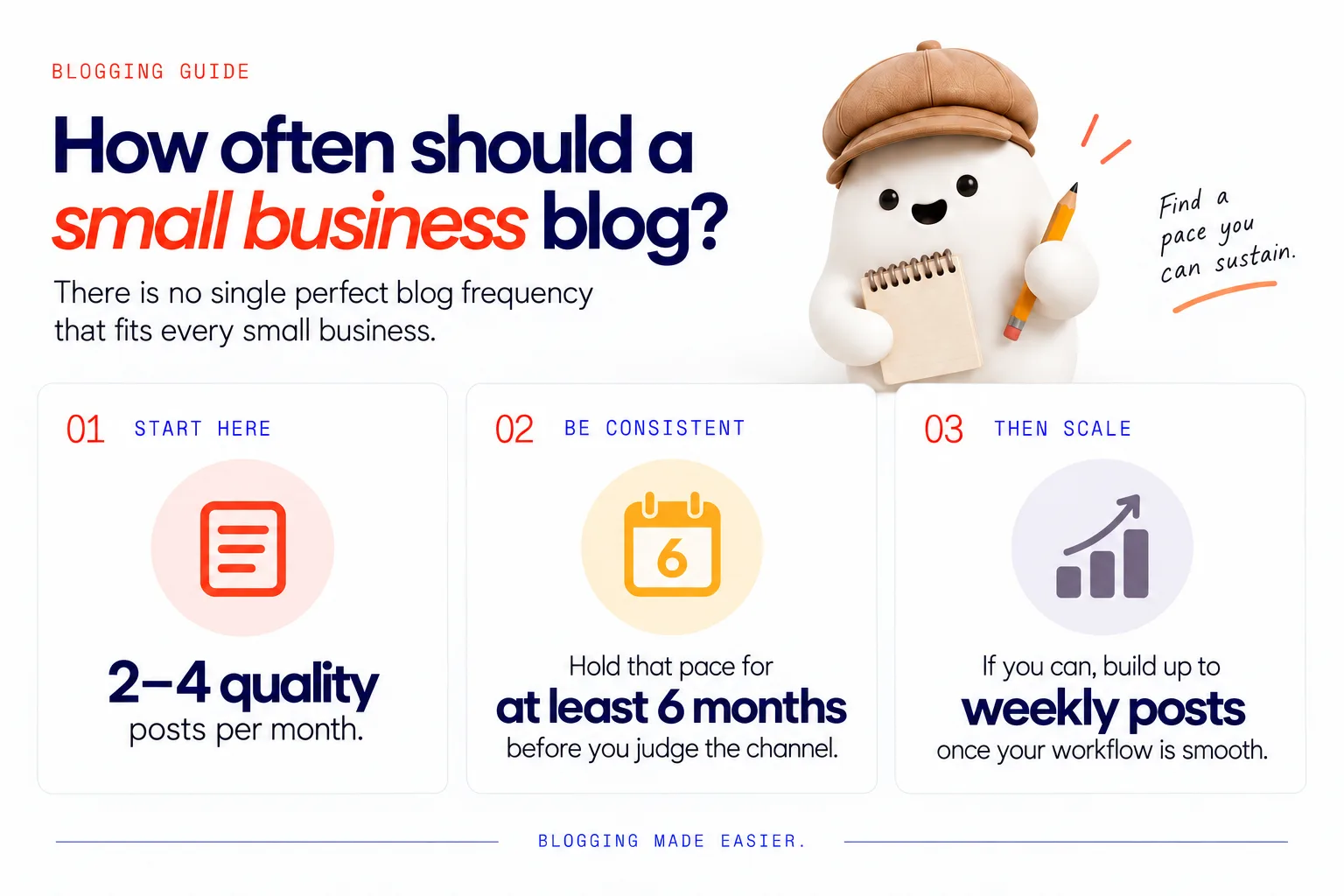
There is no single perfect blog frequency that fits every small business.
Marketer Neil Patel points out that there is no single ideal blogging frequency and that businesses should set their cadence based on their industry, their SEO goals, and the resources they have. That lines up with what we see when we work with small businesses: the “right” answer depends on your time, budget, and how quickly you need content to move the needle.
If you want a practical starting point, this is the guideline we recommend most often:
- Start with 2–4 quality posts per month.
- Hold that pace for at least 6 months before you judge the channel.
- If you can, build up to weekly posts once your workflow is smooth.
Two to four posts per month is enough to build meaningful momentum without taking over your entire week. It also gives you room to cover different topics and keywords, without burning out after one intense month and then going quiet.
From there, think in terms of tradeoffs:
- If you publish less than twice a month, results will usually just take longer.
- If you publish more than once a week, you need strong systems or support to keep quality high.
The goal is not to hit a magic number. The goal is to pick a small business blog frequency you can actually sustain.
Why consistency over time beats short bursts of blogging
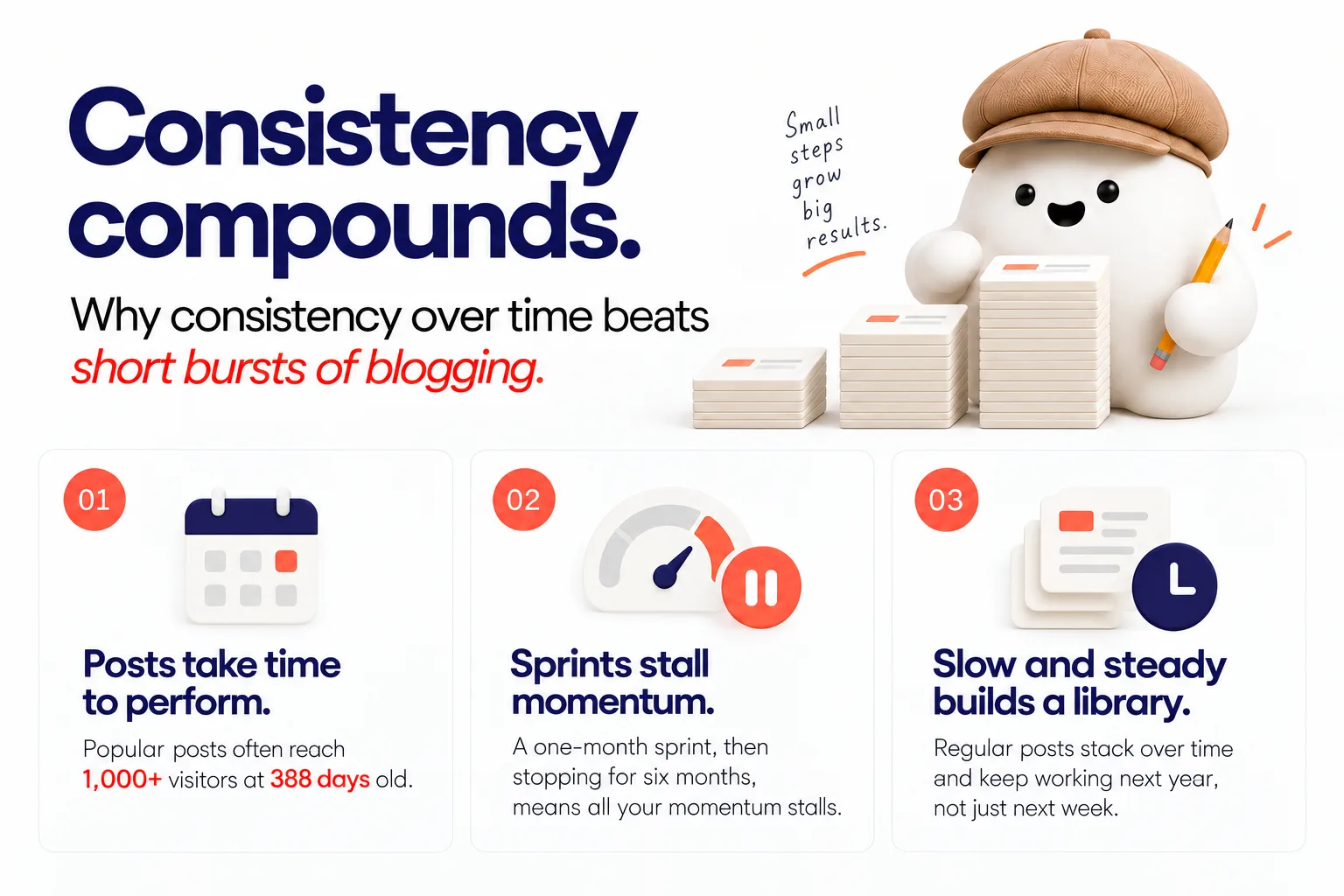
Consistency matters more than brief publishing sprints because blog posts often take months to reach their full traffic potential.
In Neil Patel’s analysis of popular posts using Ubersuggest, he found that content generating 1,000 or more visitors a month on average tends to be 388 days old. In plain language, many of the blog posts pulling in serious traffic are more than a year old.
That has a few important consequences for you:
- You cannot judge a post’s long-term performance from its first few weeks.
- Publishing in a one-month sprint, then stopping for six months, means all your momentum stalls while those posts are still “maturing.”
- Slow and steady publishing lets you stack content that will keep working next year, not just next week.
Here is what usually happens with “sprint then silence”:
You clear a weekend, write five posts, publish them, and feel great. A month later, traffic has barely moved, your backlog is gone, and other work feels more urgent, so the blog goes quiet. Six months later, those posts finally start earning impressions, but there is nothing new to build on that traction.
Now picture a different pattern:
You publish one realistic, useful post every two weeks for a year. Each post has time to age, pick up impressions, and bring in long-tail searches. While your older posts are maturing, new posts are going live and filling the gaps. Twelve months later, you have a library that compounds.
Consistency is not glamorous, but it is how small businesses win.
How to choose your starting blog frequency
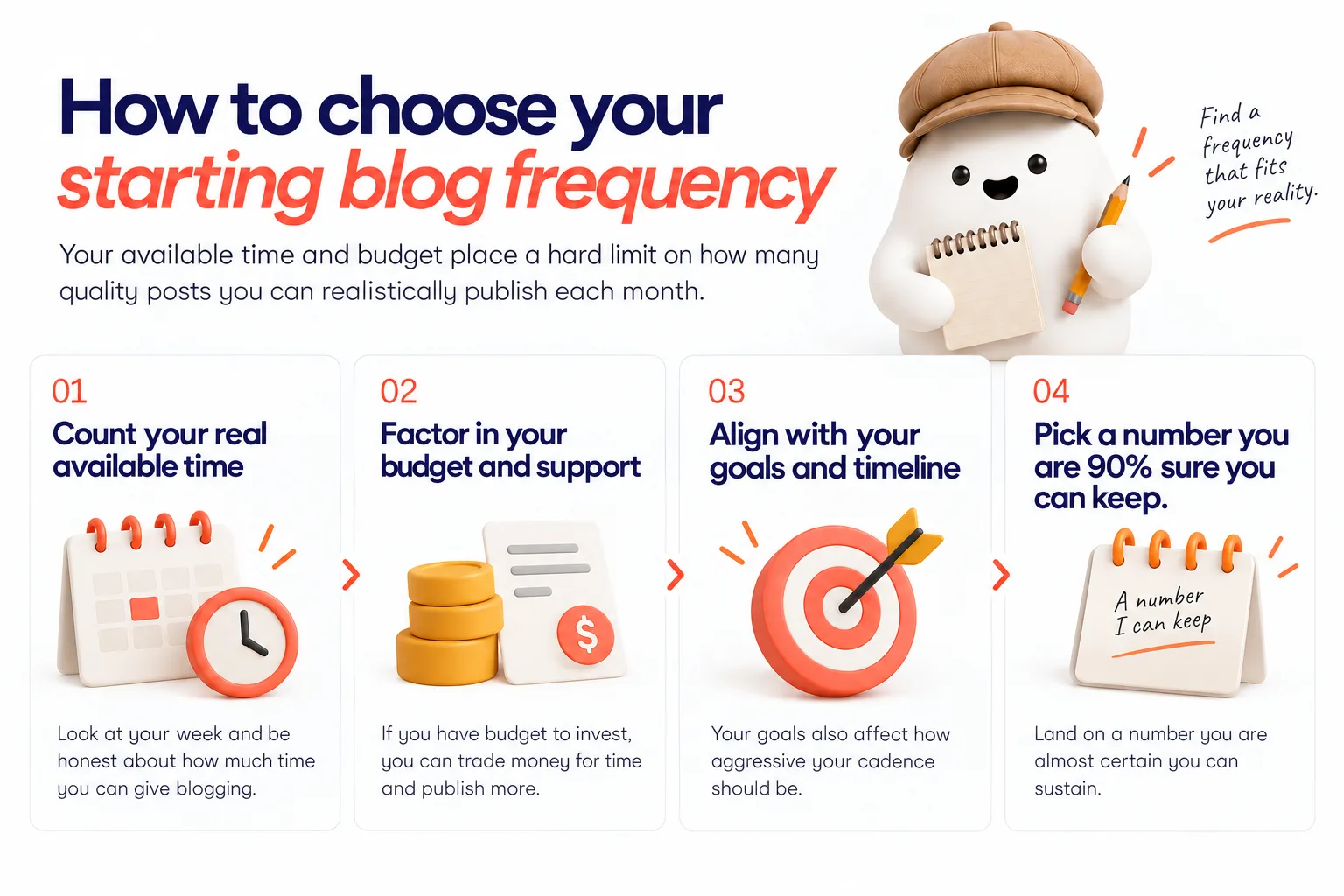
Your available time and budget place a hard limit on how many quality posts you can realistically publish each month.
You are better off owning that limit and setting a small, reliable cadence than pretending you can publish daily and then missing for weeks at a time. Here is how to pick a starting frequency that fits your reality.
1. Count your real available time
Look at your week and be honest: how much time can you give blogging, on average, without stealing from sales, operations, or rest?
For most solo or small-team owners, that might be 1–3 hours per week. Inside that window, you need to:
- Pick a topic
- Outline
- Draft
- Edit
- Find or add images
- Format and publish
If that list feels heavy, simplify by separating planning from writing. You can learn how to plan your blog posts in batches so you always sit down to a clear outline instead of a blank page.
Once you know your time budget, translate it:
- 1 hour a week often supports 1 solid post per month.
- 2–3 hours a week can often support 2–4 posts per month, especially with some templates or help.
2. Factor in your budget and support
If you have budget to invest, you can trade money for time and publish more without adding hours to your week.
Working with professionals like an SEO specialist, a writer, or a blogging assistant can handle the heavy lifting of research and drafting. Our own product, Fasta Blogging, exists for this reason. It is built by an SEO specialist and gives you weekly blog posts based on your materials, in your voice, without you needing to learn a whole new system.
Before Fasta Blogging, Caitlin charged $250 per blog post. Fasta Blogging costs $125 a month. For $125 a month, you get SEO strategy, your voice and a new post every week, for around 20 minutes of your time. That comparison shows what consistent weekly blogging can look like when you do not have to carry it all yourself.
If you are not ready to outsource, that is fine. It just means your baseline frequency will likely be lower, and you should protect that time like any other important task.
3. Align with your goals and timeline
Your goals also affect how aggressive your cadence should be.
Ask yourself:
- Are you happy to build visibility slowly over 12–18 months?
- Do you want to speed up how quickly you appear for a cluster of key topics?
- Are you trying to support a specific launch or seasonal offer?
If your timeline is long, 2 posts per month can be enough as long as they are targeted and consistent. If you want to cover more keywords and questions faster, you either need more posts per month, or more focused posts that answer tightly scoped questions.
If you are unsure where to start with topics, the examples in SEO Blog Post Examples & Writing Samples can help you see what a focused, strategic article looks like in practice.
4. Pick a number you are 90% sure you can keep
Once you have looked at time, budget, and goals, land on a number you are almost certain you can sustain.
If that number is “one good post a month for now,” own it. You can always increase later. A small, reliable cadence beats an ambitious plan you abandon.
What changes when you blog weekly? (or more often)
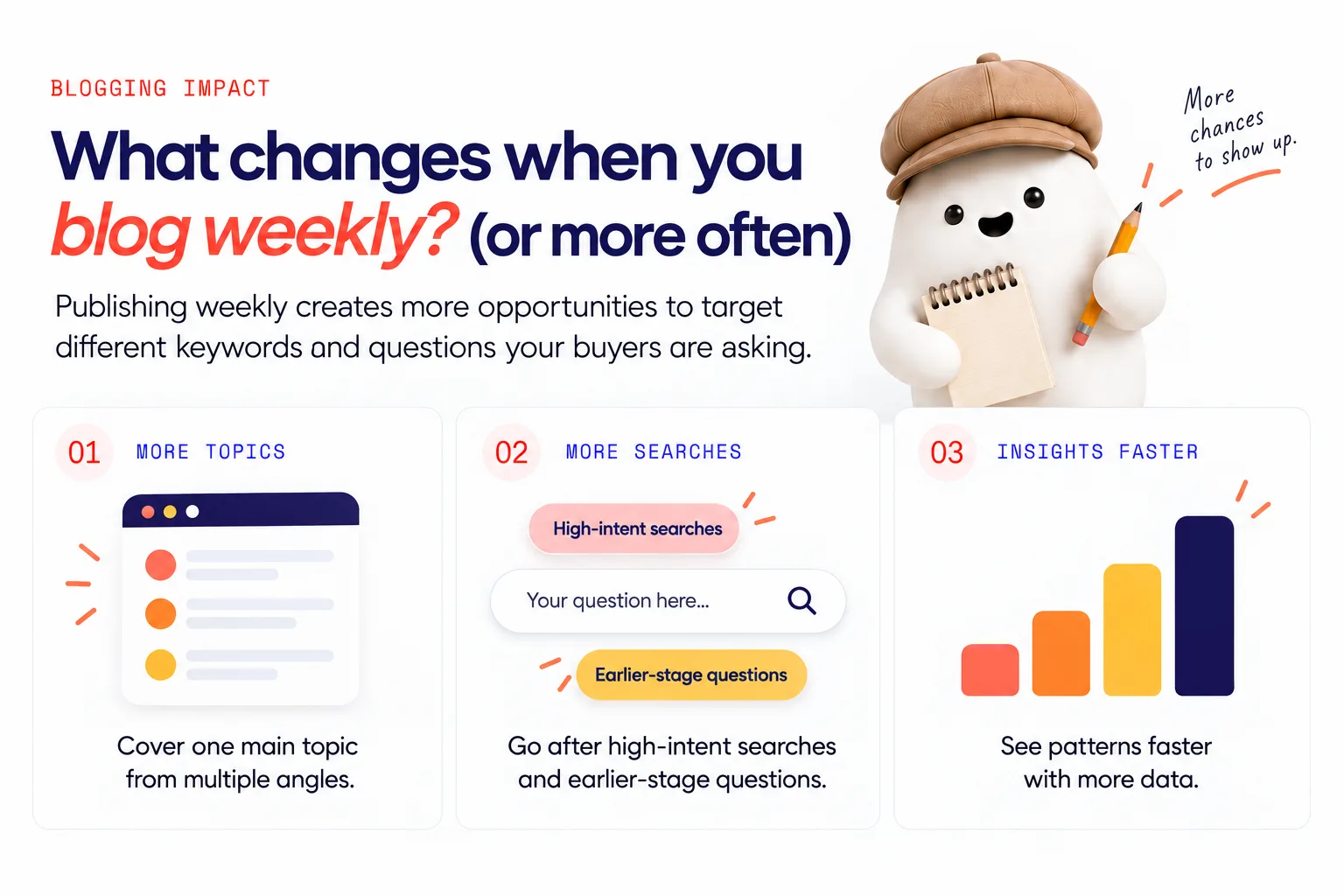
Publishing weekly creates more opportunities to target different keywords and questions your buyers are asking.
Each blog post is a chance to show up for a specific search, answer one concrete question, or attract a more niche segment of your audience. When you move from monthly to weekly, you multiply those chances without waiting years.
Here is what usually changes when a small business moves to a weekly cadence:
- You can cover one main topic from multiple angles. For example, a photographer could write about pricing, locations, outfits, and timelines as separate posts instead of squeezing everything into one.
- You can go after both high-intent searches (“hire a branding photographer in [city]”) and earlier-stage questions (“what to wear for a brand photoshoot”).
- You see patterns faster. With more posts, you get more data, which helps you see which topics and formats your audience actually responds to.
Of course, there are tradeoffs:
- Weekly posting requires a content system. You cannot rely on inspiration. You need templates, outlines, and a predictable workflow, or support tools like an automated SEO blog assistant for small businesses.
- Quality must stay high. Publishing more often only helps if your posts stay useful, readable, and aligned to real searches.
- Your approval bottleneck can surface. If every post waits on you to approve copy, images, and formatting, you will feel the pressure more when you scale to weekly.
If you are currently posting occasionally, a good goal is to step up one level at a time:
- Move from “whenever” to monthly.
- From monthly to every two weeks.
- From every two weeks to weekly if and when your system can handle it.
You do not need to jump from zero to seven posts a week for content to work.
How much blogging is “enough” to see results?
Blogging is “enough” when it brings real traffic and leads relative to the time and money you invest.
There is no universal post count where results magically appear. Performance depends on what you write about, how well it matches what people actually search, and how clearly your posts are optimized. Frequency helps, but it is not the only variable.
SEO results depend on more than frequency: topic choice, search intent, and on-page optimization all affect performance.
In our work with small businesses, we have seen focused, strategic blogging pay off with a surprisingly small number of posts. Using this strategy, we published just six strategic blog posts for one client.
Here is what those six posts did:
- 12,000+ Google impressions from a single article.
- 496 organic Google clicks from one blog post.
- A blog post that became the second most visited page on the website, behind only the homepage.
- Multiple articles beginning to rank for valuable local searches.
That is not because six is a magic number. It is because each post was deliberately planned around what the audience was searching, optimized clearly, and given time to mature.
This is why “Is one post a week enough?” is the wrong question. A better question is:
“Are my posts the right topics, written the right way, and published consistently for long enough that they can start working?”
If you are not sure whether your existing posts are set up to perform, you can check your current blog score by pasting in a post and seeing the most important fixes.
As a rough guide:
- Under 10 high-quality posts: focus on building your core library of key topics.
- Around 10–30 posts: refine based on early data and fill gaps.
- 30+ posts: you should start seeing clearer traffic patterns and can prioritize updates alongside new content.
Enough is when your content library, not just your homepage, starts pulling its weight.
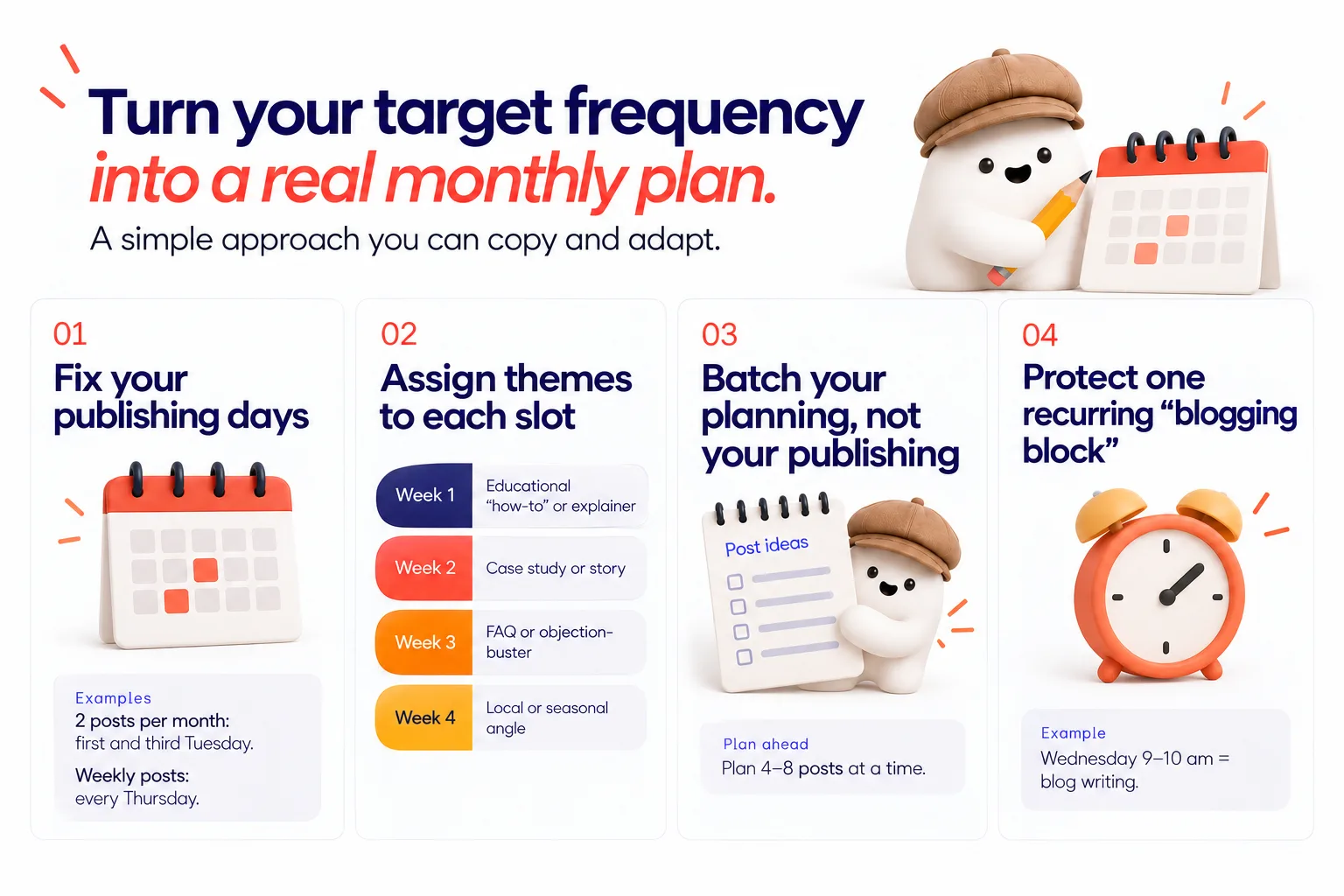
Turn your target frequency into a real monthly plan
Once you pick a cadence, you need to turn it into a simple plan, or it will disappear under client work.
Break your chosen cadence into a simple monthly pattern, for example, publishing on the same day each week or twice a month. The goal is to remove as many micro-decisions as possible.
Here is a straightforward approach you can copy and adapt.
Step 1: Fix your publishing days
Choose specific days and stick to them. For example:
- 2 posts per month: first and third Tuesday.
- Weekly posts: every Thursday.
Put these dates in your calendar as recurring events. Treat them like appointments with future leads.
Step 2: Assign themes to each slot
Give each publishing slot a rough theme so you are never starting from zero.
For example, a service business posting weekly might rotate:
- Week 1: Educational “how-to” or explainer
- Week 2: Case study or story
- Week 3: FAQ or objection-buster
- Week 4: Local or seasonal angle
If you post twice a month, you might use:
- Slot A: Deeper educational piece
- Slot B: Lighter supporting topic, case study, or client question
This still leaves room for creativity, but it gives each post a job.
Step 3: Batch your planning, not your publishing
Even if you only publish every other week, plan 4–8 posts at a time.
In one short planning session, you can:
- Choose topics that match your themes and target searches.
- Jot a quick outline and working title for each.
- Note any examples, client stories, or offers to include.
If you want a concrete workflow for turning existing materials into posts, the guide on how to turn photo shoots into blog posts walks through a quick process you can adapt, even if you are not a photographer.
Batcing means that when you sit down to “write next Thursday’s post,” you already know the topic, angle, and outline. You just write, edit, and publish.
Step 4: Protect one recurring “blogging block”
Assign one repeating block of time each week or fortnight for blog work. For example, “Wednesday 9–10 am = blog writing.”
During that time, you only do the task assigned to that week:
- Week A: Draft.
- Week B: Edit and publish.
- Or, if weekly: outline, draft, edit, publish in a simple rotation.
A small, protected block of time will do more for your consistency than a once-a-quarter weekend marathon.
Adjusting your blogging cadence based on results
You should adjust your frequency over time based on results, but give your content enough time to show those results.
Use analytics and search data to see which posts and topics are gaining traction over several months, not just weeks.
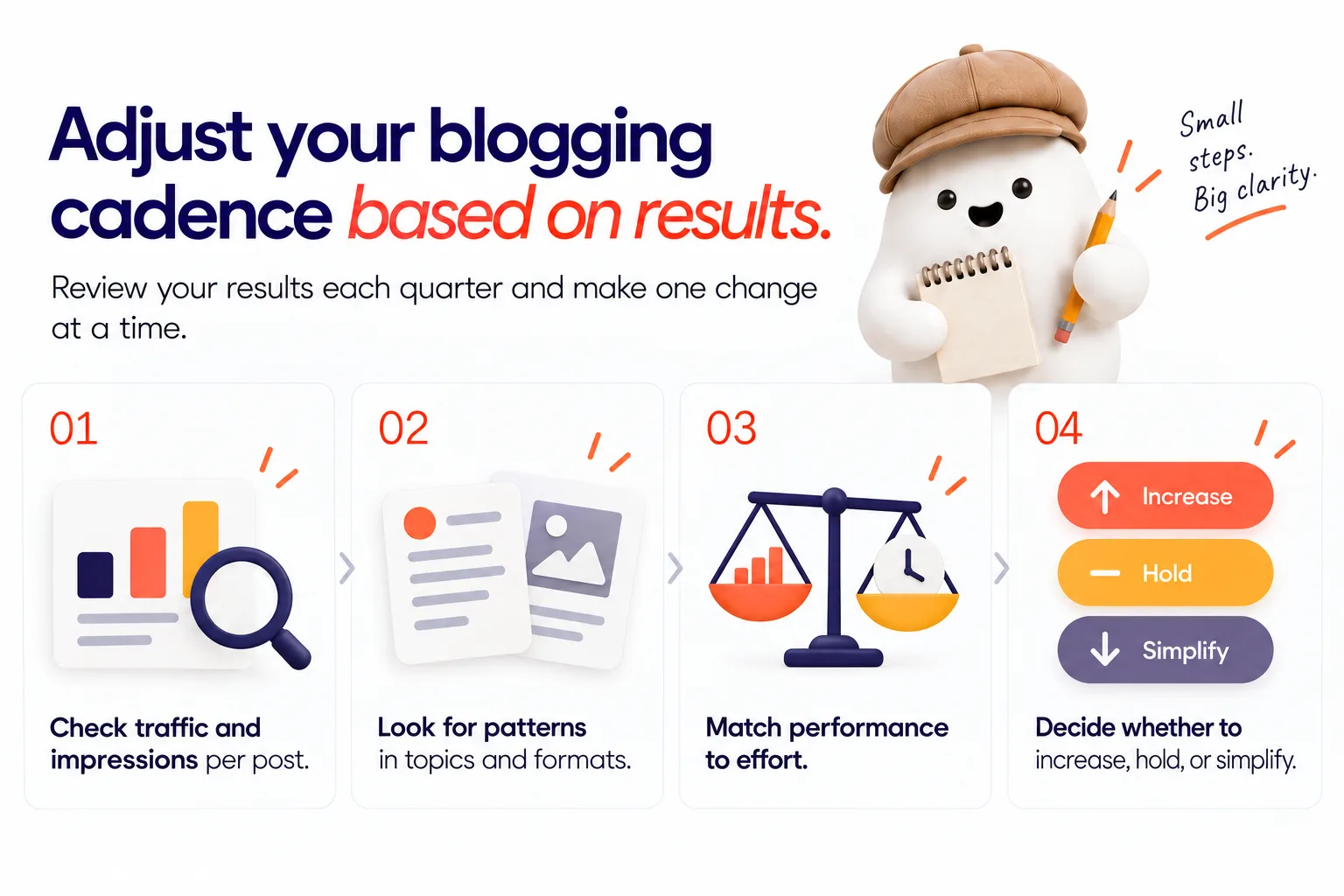
A simple review process every quarter is enough for most small businesses:
- Check traffic and impressions per post.
Look at which posts are bringing in visits or impressions from search, not just total pageviews across your whole site.
- Look for patterns in topics and formats.
Do how-to posts perform better than broad opinion pieces? Do local-focused posts attract more qualified visitors?
- Match performance to effort.
If your current cadence feels heavy but you are seeing clear traction, you might keep it as is. If it feels heavy and the results are weak, focus on improving topics and optimization before you increase volume.
- Decide whether to increase, hold, or simplify.
- Increase frequency when you have a clear process, your posts are performing, and you can invest more time or money.
- Maintain the current cadence when it is sustainable and producing steady growth.
- Reduce or simplify when your quality is slipping or blogging is causing consistent stress.
When in doubt, change one variable at a time. Do not double your posting frequency, change all your topics, and redo your website in the same month. Make one shift, give it a quarter, then reassess.
When to get help with blogging frequency
You should get help when your intentions and your actual publishing history do not match.
If blogging keeps slipping off your to-do list, your effective frequency is zero, even if you have good intentions. That is the point where outside support usually starts to pay for itself.
Common signals it is time to get help:
- You keep “catching up” with rushed posts that you know are not your best work.
- Your drafts folder is full, but nothing gets edited and published.
- You know what you want to say, but writing and formatting a post takes you hours.
- You have budget to invest, but not extra time.
Help can look like:
- Strategy advice so you stop guessing topics.
- Outlining support so you only need to “talk in your voice” and someone else shapes it.
- A recurring done-for-you service that handles planning, writing, and publishing.
We built Fasta Blogging for owners in exactly this situation. Each new account is personally set up by an SEO specialist, your posts are planned around your actual business, and every piece of content is reviewed by a human before it is ready. If you want to understand how that kind of system works under the hood, the article about our automated SEO blog assistant for small businesses walks through the process.
Whether you choose our service, a freelancer, or an internal hire, the goal is the same: turn blogging from “whenever I get a chance” into “this happens every week without me having to wrestle it.”
FAQ: quick answers about blog post frequency
What if I miss a scheduled post?
Skip it and publish the next one on schedule as soon as you can. Do not try to “make up” by rushing two low-quality posts at once. One solid, slightly late post is better than a pile of rushed content.
Is it bad for SEO to post multiple times in one day or batch-upload posts?
No, posting more than once in a day is not inherently bad. The bigger risk is dumping a batch, then going silent for months. If you must batch-upload, still plan future posts and updates so your site does not look abandoned.
How should seasonal businesses handle blogging cadence?
Seasonal businesses can keep a steady low cadence year-round, then add extra posts in the ramp-up to busy season. Use quiet months to write and schedule posts, then let them publish on your chosen dates while you focus on serving clients.
Can my blogging frequency change over time?
Yes, your frequency can and should evolve as your capacity and results change. Start small, build a system, then increase or refine your cadence once you see what works and what you can sustain.
If you want someone to handle consistent, strategic blogging for you, so you can have a new post live every week without adding hours to your workload, you can learn more about Fasta Blogging at Done-For-You SEO Blog Writing Service.
Roast your blog post
Paste one post and get honest feedback on structure, search and readability.
Get your free roastNo account needed
Or skip the roast and have us write them: start blogging.
$125/mo · cancel anytime